§ 01Listen · Watch · SubscribeVol. XV · № 01
§ 02About this episodeVol. XV · № 02
Ash Ali and Hasan Kubba on the idea that every founder has a built-in advantage.
§ 03Show notesVol. XV · № 03
§ 04Full transcriptVol. XV · № 04
Read Full Transcript ▼
Unknown Speaker 0:05
When things go wrong, we sometimes blame others. And other times we decide that there is something inherently wrong with us. And hence, that is why we will never become successful.
But what if I tell you that each one of us has a unique, unfair advantage
leveraging which will make us successful
Rather than me telling you about your unfair advantage and how to leverage it, why don't we speak to a couple of gifted entrepreneurs who have tons of related experience and expertise.
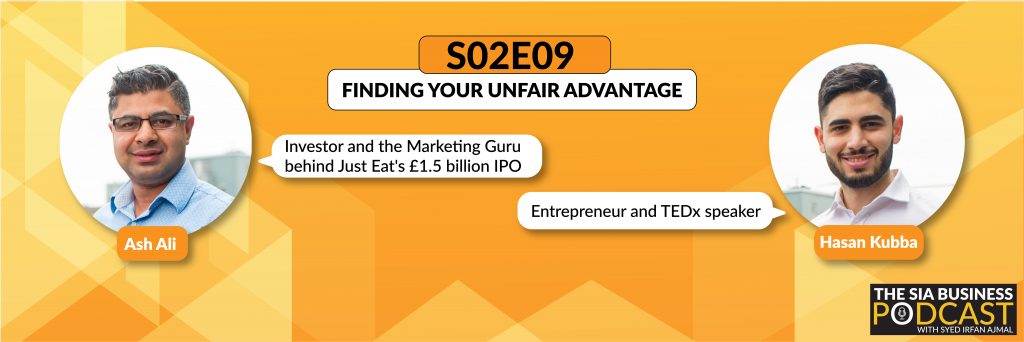
Our guests today are Ash Ali and Hassan Kubba, who are startup entrepreneurs, and the co authors of an upcoming book called The Unfair Advantage.
Born to immigrant parents, there was crime and poverty, all around ash in Birmingham.
Plus, he didn't go to a university either
but
became the first marketing director of just eat an online food order and delivery startup. And his growth hacking and marketing skills were instrumental in growing just eat, which IP owed at 1.5 billion pounds.
Hasan built a successful startup from his bedroom, with nothing more than an online course and a yearning to escape the corporate rat race. They have each spoken at TEDx advised and mentored hundreds of startups all over the world. And they are both passionate about spreading the opportunities of startup entrepreneurship.
So let's speak to our guests.
You're the average of the five podcast shows you listen to the most.
Learn to run your business well with the SIA Business Show where our hosts say their fun nuts mo interviews entrepreneurs, marketers and speakers of all colors and creeds revealing their biggest secrets and lousiest mistakes.
Ash and hazard Welcome to the show. Thanks for having us. Hello. How are you bought? And where in the world are you both located at? So I'm currently in northwest London in Edgware. Yeah, I'm in northwest London as well. Right. So before we discuss the book and the philosophy that it comes with, I would like to know what was life like for both of you? What about you ash? What is it that you were doing before? You ought to
misspoke. So I've been in the entrepreneurial trenches for most of my life actually, I started my first thought website when I was 19 years old. So I've been building websites and been in the digital industry for about 20 years now. And the book came about after going on stage and speaking about my learnings and stories of starting startups and growing them. Perfect. Sounds good. And what about you hasn't? So yeah, I was born in back that first of all, London when I was three years old, with my family. And then my path was that typical kind of immigrant path. They don't want to take risks. They want you to be a doctor or an engineer. That's not a typical kind of Iraqi parents thinking that I was on the path to becoming a doctor. I dropped out of university realized it wasn't for me. And later down the line, I started my own online business. And I grew that to the point where I was making passive income. It was great. And, yeah, it was that success that initial success in my own business.
Which kind of made me interested in investing in startups and looking at success? Sounds very interesting. And was that startup focused on online education? It was a digital marketing agency actually. Right. Right. Okay. Local clients there, London. Perfect. You also mentioned that you've worked on an online course. Right? So I just want you to know a bit more about that, if possible. You know, I took so that's how I started is I actually took an online course, I finished an economics degree of medicine, and kind of the typical path is sort of banking, or working in the city or in finance, but that didn't really appeal to me site. So why did instead is I I found an online course about starting your own online business. And it was from that, but I learned all this stuff. I was too scared to start. I got some sales in the city in the meantime, but then eventually I went through it. Right. It's amazing how, despite the fact that a lot of parents especially you know, parents who are from Asia,
I believe so we had guests from Malaysia, Singapore as well, you know, who had their parents sort of forcing them or pressuring them to, you know, go down that traditional route. And it's interesting how you know, someone like you ditched University and you know, actually learned much more via an online course. Right? Yeah, yeah, it's definitely here's the funny thing that Yeah, all all Asian parents, that seems. I mean, I can understand where they're coming from, you know, they want that stability, that security. That's all they know about, you know, these kinds of entrepreneurial opportunities didn't really exist before in the kind of 20th century thinking of getting a secure job. Nice professional, and getting the stability from the kind of understandable but you know, times change. Yeah, yeah. And ash, I know that before you joined, just eat you were one of the earliest employees there. And of course, you were the first marketing director there. I believe you also had some entrepreneurial strain strikes. So what was that like? And what made you decide to you know,
Have a corporate career of sorts at just eat. Yeah, so my initial idea of being an entrepreneur was when I was 13 years old, and the newspaper around, and then I started selling CDs at 16. And I had it in my blood to be an entrepreneur naturally and try and make money. And money for me meant freedom and choices and options. And then when I was 19, I built this website. And that was quite interesting. And I won a couple awards for it and moved to London. And when I moved to London, I actually joined a corporate, a corporate company. And that corporate company gave me a great foundation and setting to learn about how you do things in an office environment with other people and work in teams. Because when you're an entrepreneur, you normally work with freelancers, and you're solo, or you have one partner. And it's very different when you're working with bigger teams and bigger clients of different stakeholders. And so I learned a lot about office politics life in our working in an office working in a team, working with corporate clients, and also the ability to have impact so the reason why just eat was that
There's going to be impact, we're going to go nationwide with a start up, and also Europe wide. And that really excited me. And it was something completely different. Because everyone else was nodding their head and saying, nobody's going to want to take waves online. And I always kind of do do the opposite what everyone else is saying. And I've done that as a child as well, my parents keep saying it, you know, everyone's working one way you're looking the other way. I said, tend to do that with just D as well. I mean, I think that's a very good point that you raise, do you think that fi entrepreneurs, we are kind of suspicious of the consensus and the whatever the majority is doing or thinking? I don't think it's being suspicious of them. I think it's a we are finding gaps in the marketplace and being contrarian. And there's always going to be a different way to do something. And perspective is very important. Yeah. So what happens is when you're in the corporate office world, or when you go through education, you're taught to think in a certain way and pattern and you try and do a lot more pattern recognition. Whereas when you're outside of that your pattern recognition changes to your perspective, and that's why it's becoming more and more important.
larger organizations and firms to have diversity at the top of the in the leadership teams, because it's very important to have different perspectives. Just add to that side. I really think that it's the kind of a being a nonconformist. There is there's definitely a correlation between non conformance and being an entrepreneur. Yeah, absolutely. It's It seems that with all entrepreneurs, and they're weird, but interesting quakes, and they are amazing products and everything. So I know that you guys quote, even Spiegel quite often in some of your talks, when he mentioned that, you know, I am a young, white, educated male, I got really, really lucky and life isn't fair. So I mean, is that what an unfair advantage looks like? And does that mean that there is no hope for the others who are not, you know, young or white or educated? Yeah, good question. Let me touch on this because this is something that I kind of researched myself. You know, it was it was a really good kind of starting point, or a really simple way to explain unfair advantages, you know, right from the horse's mouth.
his youngest self made billionaire at the time, you know, the answer is this one fair advantage looks like it's what an unfair advantage can look like. But there are so many different ways it can manifest itself. So that's like the kind of straightforward, typical example of an unfair advantage. But it doesn't mean that's the only way an unfair advantage can exist. So unfair advantages can have double edged sword. That's one of the big points that we make in the book. Otherwise, it's very motivational thing if you're not born, young, white and rich, really, it's more about what do you have in your circumstances or your personality or your talents, that's giving you an edge over the competition sort of naturally. Right? So it's a case of sometimes you can turn what seems to be a disadvantage into an advantage if you have the right mindset. So it's a good example of one but another example of an unfair advantage is Oprah Winfrey. We use her as a big kid.
Studying the book. So Oprah, as I'm sure everybody who's listening to this has heard how massively massively successful she is Oprah Winfrey. She's a self made billionaire as well, one of the, I think one of the richest black women in the world. There's something along those lines. And her background is very, very underprivileged. But her unfair advantage was her talents at speaking and reading and doing public speaking and speaking to an audience. So she kind of turned her disadvantage off, you know, of being poor or having a very traumatic childhood. She turned that into an advantage and strong emotional intelligence of being charming and relatable in her daytime TV show, which means that the queen of daytime television in America and kind of give her the big success that she had. Got it. So how can anyone find and leverage their own unique unfair advantage? That's a really big question. Interesting. One, when we have
When me and Hassan [inaudible] sit down and write this book together, we felt that there were so many different places where we could start in how you can define what an unfair advantage is for yourself. And it's not just one thing, it's layers of different things that make up what an unfair advantage is. So we created this framework called the MILES framework. And I'm sure Hassan can explain what the MILES framework is now. So yeah, the the MILES framework is how we kind of codify all the different types of unfair advantages, and all the different categories. We thought about the concept and we thought, Okay, so what kind of unfair advantages are there and we kind of broke them down. So we've done so much research into this. Firsthand in the entrepreneurs that we've mentored ourselves, on hundreds of startups and entrepreneurs, which we've advised and mentor, just as research for this book, really, and just in terms of getting back. And secondly, just from looking at success stories as well, you know, big unicorn successes, and we've broken them down into this acronym, which is MILES. MILES stands for money, intelligence and insight,
location and luck, education and expertise, and finally, status. So if you… the first letter of each of those words spells out MILES, and so those are the kind of categories that we put them in. And we've kind of made it into a diagrams in our book as well, where they're like pillars. And they're built on the foundation of mindset. So if you'd like I can go into each one, you know, in a bit more detail just to explain them.
[inaudible] straightforward... It's the money that you have or that you can raise. So it really helps to have some money starting off because you know, when you have to start a startup, there's nobody paying your salary, especially if you do it full time. You can do as a side hustle as well, which we do recommend if you don't have the savings to be able to kind of support yourself and your family… if you have family that you have to take care of as well. What is really important… and also there's some.. some businesses can be more capital intensive than others. Some businesses can take longer to become profitable than others. It will take longer to be able to pay yourself so money is definitely needed.
Intelligence and insight is quite an important category as well. Intelligence in the typical type of IQ, also social and emotional intelligence, this is another thing that's really important. Creative intelligence is absolutely massive. And finally, insight, you know, having a deep, unique insight into a problem that you can then solve, you know, it's like finding a gap in the market is absolutely essential. So that's ‘I’, you know, intelligence and insight. Location and luck is an interesting one, because it's all about being in the right place at the right time. You know, it's all about that taking that opportunity in the right moment. So timing is one of the biggest factors of… for startups, successful or not. If you're too early, then the technology might be too expensive or not ready. The market might not understand how it works. So you have to spend a lot of marketing.. educating the market, you know… a lot of your marketing spend will be spent on that. If you're too late, there's too many competitors. So the timing needs to be right and, you know, this requires some luck as well…
luck and intuition. And also it's about being in the right place, you know, there's a reason why Silicon Valley is such a big startup hub. There's a reason why London is kind of the biggest startup hub in the in Europe. There is a reason why, for example, Shenzhen is a big hub, especially for hardware companies in China. So being in the right location matters, because you can have access to the talent and to the investors, you can have access to the right economic opportunities and financial stability. So that's a big factor as well. We move on to ‘E’ for education and expertise, which is all about having the right skill set. Let's say in your founding team to develop your product, you know, to solve the problem that you found in the ‘I’ in your insight. So if ‘I’ is to figure out the problem, ‘E’ for education/expertise is to figure out the solution. Right? And then finally, we have status which is massive so it’s how you come across to people. It's how… do you come across as credible? trustworthy? Can people have confidence in you? So there's
internal and external status. External status is how you come across externally. Internal status is how you feel about yourself, which also affects how you come across externally, you know, your confidence and your self esteem. So that kind of gives you a feeling. Also part of status is your network. So our book is kind of filled and brimming with examples and case studies and even talked about it in my TED talk as well. So, that kind of gives you an idea of what the MILES framework is and the different types of unfair advantages there are. Got it. This is very interesting. I do have a good few questions about the different pillars of the minds framework. So what I will do is that I will discuss these one by one starting with money, is that okay? Yeah, go for. Okay. So like, for instance, we come across a lot of startup founders or entrepreneurs or wannabe entrepreneurs who will use money as an excuse that, you know, the reason we can't succeed is we don't have the money and you know, we can't raise the funds. You know, the investors can't see how brilliant
And amazing idea this is. So is that the right approach to go with is that the right mindset? I can take this one actually, because this is an interesting one. Sure, money in, I grew up quite poor in a very poor neighborhood. And I never had access to much money at all. And one of the things I learned about money was quite interesting. When I became the when I was at just eat, I was given a marketing budget that was very, very small, a monthly marketing budget. I was a one man marketing machine at the time, the whole department was being in the early days. And then we raised within a year we raised 10.5 million pounds from index ventures ABC Company, and they gave us we actually managed to get three and a half million pounds for marketing. And remember the shift in my mind and how difficult it was for me to shift from having no money to having lots of money for marketing. So you had a new crazy because I had a new problem. And I realized something that actually what happens is that when you have no money, you have to be resourceful, and creative. You have to come up with new ideas, new things, and it's
That that limitation of money makes you more creative makes you more of a hustler to find different ways of doing things. And that's actually quite a good constraint to have sometimes, because we need it flush with money. Guess what we did first thing? We did a TV advert that cost us 200,000 pounds. Right? Yeah. Easy, right? Yeah. Then you can talk what was easy to decide that but hard to actually do the advert in the end. And so the whole creativity and I was dead against this, I was like, Oh, no, you can't, you shouldn't do TVs Not really. But actually TV made a massive difference for us in terms of building our brand as an internet startup company. So having money is very, very valuable when you know how to use it. But having no money is also useful. It gives you constraints and makes you think about being more resourceful. So it's like a what we call a double edged sword in that context. Another reason why it's quite interesting is that I personally never had any money. So when I started projects, I had nothing to lose. And now I'm in a different position where I've thought about it and I have got something to lose. The mindset changes slightly
is quite an interesting shift in how you think. So it's important to understand that money is not always the answer. Absolutely. And to share a bit of a personal example, I realized that when I do have the funds to, you know, spend a bit more on our content marketing or something like that, sometimes I inclined towards spending more than I should I'm supposed to spend, right? Like, it is as if I am subconsciously defending my decision of spending that much by saying, you know, okay, we didn't spend a lot previously. So you know, let's go ahead and spend a lot on this. And later on, I would be like, you know, why did I spend this much because this was not necessarily that valuable. So when you give example of spending 250,000 pounds on a TV ad, do you think that was just luck that you guys succeeded in building a brand through that ad or was there you know, a lot of insight that went through in reaching that decision. There was actually a lot of insight around why we want to do that. I think also you have to take into consideration the timing.
The market This was 2008. And this was an early days. And we were one of the first online takeaway ordering platforms. There were a couple of others out there. And we wanted to make sure that we stamped our mark. And also, we were one of the few startup companies in the sector that was quite national, meaning across the major cities and towns of the UK, where some of our competitors were only localized into London or certain cities. So we had an ample opportunity to take that brand positioning, and position ourselves as the leading takeaway ordering service. And that's why we did it. So there's lots of reasons behind what we did. And there's also lots of learnings around how he actually made some mistakes as well. We had a couple of failures around that. But it was interesting. That was the open factor. And it wasn't just a TV campaign that did it. So it was the fact that people now because seriously, so all those people I was looking to talk to to do partnerships, now returned by calls. All these people I wanted to do deals with, they start to take us more seriously. So the door started
to open up a bit more. So the branding was not just on the consumer side to get people aware of what we are, who we are, and we exist, but also to remind people in the business world that we are serious player and we are going to take this market. Perfect. That sounds very good. So in terms of status hasn't mentioned earlier that, you know, there is, you know, an internal status, like what you think about your own self and all that. And I think that, that is kind of relevant to my question about the need for self awareness, when, you know, finding your unfair advantage. So how do you how does one become more self aware? Or what are some of the things that you guys do to, you know, take the time to reflect upon things and find your own or your startups unfair advantage? Yeah, it's interesting. You mentioned self awareness, because that's such a big factor in the book, in our whole mindset, philosophy. It's just so important. It's just that kind of self knowledge, knowing thyself. So so important. So
You mentioned it in terms of status. So essentially, what it takes is to, to know yourself better to have that self awareness is kind of the whole goal of the book really, is kind of give you the self awareness about your own inner self, and also about your circumstances and your situation. So one of the biggest ways to get that self awareness and to find your advantages is simply to know that they exist. Right? You know, it's interesting, because the feedback we get about the concept of the unfair advantage is kind of like, Yeah, that makes sense. I knew that. But nobody has explained it. I didn't know it consciously. It was like a model in my brain, right? Like, we don't tell this to people, and they're like, No, no, that's completely wrong. We disagree. That doesn't happen. In fact, what happens thicker? Yeah, that's so true. That's so true. And nobody's explained it that way before and that was kind of our goal. It was like to explain the truth that we're all aware of, but we're also you know, we know it kind of subconsciously and where it's a little bit fuzzy, right. So first of all, is
To bring to the forefront, right? There are no, especially in the West, like people might kind of think that this is a pure meritocracy, and that it's like a level playing field that everybody can kind of, you know, everybody succeeds because they fully earned it. Right? And then there's the opposite mindset, which is, yeah, it's all like luck. And it's all fate. And there's nothing you can really do. And they just got lucky. You know, there's this mindset as well, which they have. And it's kind of you have to find that midway point, and understand that the unfair advantages exists. So that's step number one is just know that they exist and learn about step number two is to know the kind of passing is that they fall into which we've kind of broken down with the MILES framework. And just knowing that and looking at examples that we go through, you can kind of look at your own life and your own circumstances and kind of think, Okay, I think I've got this one. I'm strong in this area, but I'm weaker maybe in maybe I'm strong in insight and intelligence. I'm weaker in my expertise side. I don't really know how to build a solution to solve the problem. I don't really have more
much money to spend on it. But I can kind of survive a few months, maybe without a salary. You can kind of rate where you're at. And just bear in mind as well. Some people often ask us is do I need to have all the unfair advantages to succeed? The answer is no. You don't need Well, you can do is partner up with a co founder, or have you early employees or early mentors kind of plug in the gaps, you know, give you those complimentary unfair advantages that you're that you don't have. So yeah, the self awareness comes from knowing it, and kind of reflecting on your own life and just kind of be more aware of how it works. Yeah, I think status is quite an interesting one. And hasn't, it's absolutely right. Being aware of it. It's being self awareness is one of the most critical components of knowing who you are and how to work on your strengths and double down on your strengths. Now,
I went through school being tested on subjects, and I did okay at school, actually. But there was certain other…there were certain subjects I didn't do very well at. And I realized that the teachers were like, right, you know, you're not very good at this and don't even think about going into…
create in this this area like…English. And we've written a book. It's funny, right? And what I found was that when we go through the system, everyone keeps telling you what you're not good at. But what you're good at is like a tick, yeah, well done, you've done that, that's fine. But what you're not good at is like, well, you need to improve that you need to change that, to improve that. And then I realized as I went through my entrepreneurial career that actually, I'm good at certain things, and not so good at other things. And that was only self awareness that I started to get later in my life. Whereas at school, you have to try and be good at everything, and average yourself out. [a]
Whereas as an entrepreneur, I realized that you have to be very good at certain things and have a spike in terms of… if you look at it as a graph…
in certain type of traits that will make you a really strong entrepreneur, but find people who can fill the other gaps where you find people who can actually help you with the things that you're weaker. So the whole idea of the MILES framework is to allow you to audit yourself to see who you are, but also to use it to audit other people so you can see how what their strengths are and how they fit into your team. Because everything is done in a team. It's not a single handed thing.
That's the other thing I realized in life, it's not just a one man band, you have to have a team that helps you achieve success. And being self aware allows you to fit into the right team.
And so, all my life, I've been told this that you can't release, you can't do that. And then gain through self awareness, I realized that I do have strengths, actually. And everybody has them. You know, everyone is unique. Everyone has a special talent. The whole idea of this man's framework is to show people that you are special, you are unique. And you're in this world with a unique talent and a set of unfair advantages that you can take advantage of, to leverage. And so
When I came to London, I start to look around me and I thought, oh my god, everyone so rich is doing so while I'm filming. I don't know how it works here. And I start to have this thing called, should I even be here? I'm not even allowed to be here. And I rater realize this is called imposter syndrome. And then I realized, being an imposter, it felt like why am I here? Why should I even be here? So believing in myself and having self confidence was another area of self awareness, but actually no, I have the right to be here. I have the skills expertise. I have the knowledge I am doing the right
Place, I just need to make it the right place. And sometimes people go through life and say, um, shouldn't we be here? Should we really been doing this? And that's becoming self aware of who you are, and what you're good at and what you're not good at. And then, eventually as this imposter syndrome, and I still have it now, actually, sometimes I'm on stage, and I'm like, should I even really be here? Who am I to be telling all these hundreds of people in this crowd, how to do marketing? And then it kicks in again, to say that actually, I need to tell better stories in my own mind. So the status the external status is great. Yes, you've been part of startups and IPO. You've written a book your authors, that's great. But the internal status is actually what do I tell what stories do I tell myself in my own mind? Who am I really? How do I see the story of my own life? And then utilizing that to create authenticity in who you are, and realizing that actually, you're unique and you're your authentic self? And that part of my self awareness has been the biggest enlightening moment for me and I'm still learning a lot more about myself. But do you think that like this
No doubt or this conversation with yourself where you are feeling like an imposter, do you think that it has also to do when sometimes inadvertently, we end up comparing ourselves with someone else. And we see just external status, right? We don't know what demons they have or what problems they are going through. So do you think that it's better to just, you know, focus on trying to be better than what we were yesterday or a week ago or something? Absolutely. So when I start to get context of my own personal life journey and hasn't got his context of his own personal life journey, we realized that there are moments in life that we've had some really brilliant moments. And there are moments in life which have not been so great. But what we are comparing ourselves to is our previous self. And the way I see is that I was born in the inner city of Birmingham, and I've come from a small town called small leaf. If any of you are Peaky Blinders fans, you'll know where that area is. But small town is small leaf and I'll come to London and a big
got involved with the largest tech IPO in the last 10 years? How is that possible? What's that journey and so, I know other people can be also part of that journey. And they have been, but they have to compare themselves to who they were yesterday, like you said. And also another thing, one thing that I notice quite often, and I would love to know what you both think about it, is that a lot of times someone will have the, you know, the innate talent, something that they are born with. But when they don't do very good with that talent, they assume that they can never be so good at it, that it will become a professional skill is something that they can use to have a successful life. So you know, the journey from talent to skill is what I'm talking about, like, you may have the talent but you still have to work on it and through education or expertise and get to the level where, you know, I don't know after 10,000 hours or something like that, you become the expert and you have the skill, the Polish skills, right? Absolutely. This is so essential. So yeah, that's
The concept of talent is very interesting for me in my personal life. It really took me a long time it took me most of my 20s just trying to figure out what is my talent? What am I? What's my main strength, and it takes time. So if you're young, or listening to this podcast, and you're like, how I don't know what my talent is, don't worry, it takes time to figure out sometimes, you know, not everyone really knows straightaway, what they're really good at. The best way to figure it out is sort of empirically meaning in the field. By actually doing stuff in the real world. You can kind of figure out what you're good at what you like, which is also important. It's also important to kind of enjoy it. And oftentimes they go together. If you're good at something and you start building the skill set. You start to enjoy it right. So are you asking about what do you do with a talent that you lose faith in or you don't think is good enough? Right? I think it's a case of, first of all, you've got to keep working at it. Like you said, the 10,000 hours rule spoken about often enough.
You know, hard work beats talent, when talent doesn't work hard, there's that kind of quote, it's definitely true. In most cases, there are some complete outliers who you see, they really don't work much at something, but they're just amazing at it. There are those who are there's no keep comparing ourselves to them. And just like you said, then that's when you can have that comparison syndrome, you know, the idea of like, Oh, no, I'm not as good as this person. And, and ultimately, you're really you're, you're just comparing yourself to an image that that person or the media has projected out into the world, right? It's not really, you don't know the inner demons that they have, just like what you said, I can go quite deep, you can go quite deep. So this is that's one of the reasons that why we focus on the idea of gratitude. Right? It's really important. So one of the things that we really actually thought about this so long, that's one of the reasons took us longer. thrivers because we were like, We don't want to write a book where somebody is gonna think, Oh, just because I don't have unfair advantages, then that means I'm not going to succeed.
That's not how it works. Everybody has unfair advantages, and we wanted to make sure we communicate that clearly in the book. So the idea is that if you have, you want me to have the mindset of gratitude, when you look, you need to focus on what you have going for you, not what you don't have, because you'll be surprised to see how many things you do have. Yeah. So So instead of focusing on the weaknesses, focus on your strengths, right? Yeah.
Look about you know, in school, they tell you, oh, you need to improve in this area, where your weakest, but you know, in the real world, in business and in your career, you don't shouldn't focus on your weaknesses. In the most in most cases, you should focus more on your strengths, and delegate and work in a team to people who have your weakness as their strength. Right. And that's kind of the myth that's been kind of given insight, even the show of the apprentice, right? We have that in the UK as well. And they kind of give this mindset where to be an entrepreneur, you have to be good at everything. No, you don't. You just need to be really good at a few things.
And then have in your team or with your business partners or co founders, the strength that you're missing? Simple, right? So it's a case of focusing more on that. And in terms of uncovering your talents, it's just a case of trying different things, working on different things, gaining the feedback, increasing your self awareness of your friends and colleagues, what am I good at? You know, try and find what comes naturally to you. You don't even think it's like, amazing, like it's a talent. You think it's normal, but other people tell you Wow, that's really hard. I can't do that. That's kind of gives you the clue of where your talent long. Yeah. And also it depends on I think, as we get older as adults, we get this curiosity knocked out of us. And as an entrepreneur, being curious is very important. As a child, you're very curious. And you always want to learn new things. And it's usually what you love as a child that you really easily economy in natural talent when you're actually an adult. So you might be great at sports and you might be talented in sports, but actually now you have a job and get a mortgage and have two kids.
It becomes like, oh, while you lose that talent for that sport that you had, I never had the opportunity. And some people do get the opportunity to fulfill that talent. And the other part of talent is also to realize that as an entrepreneur, you don't have to be the most talented person. Your job as an entrepreneur is to get the right talented people around you to fulfill your vision. And there's a new trend, another trend, I think, as an entrepreneur, you need to have a lot more generalistic skills to become an entrepreneur than just having a super talent in something, because that by itself is not going to create the vision that you want to fulfill because there's so many moving parts to a business and a startup. So having general tech skills are becoming more and more important, but also having other skills which are not just hard skills, which we call like, you know, programming coding music. You got to have what other side of this because it's people call them soft skills, but I call them human skills, the ability to work in teams, emotional intelligence, the ability to communicate the ability to work in a team effort. For example, these skills are becoming more and more people
I'm just having a super talent. Because I know I've always run with this philosophy is that if I have a team, and I can find someone in my team, find someone to hire, and he's super talented or she's super talented, but they've got a bad attitude, I won't hire them. They'll make the harmony in the team not work. So talent by itself is great. But having the ability to have other skills are also very important. But knowing what you're good at is a good thing. And I think sometimes we get it knocked out. In British schools, it's very much like, well, you don't really talk much about in America, it's like, yes, I'm the best at this. They have such a somewhat different way of looking at it. And in Asian culture and my background, it's very much like you don't say anything, you respect the elders, you just shut up, stay in the corner and just be quiet. Don't even start a debate on something don't even think. And that's how he's my life used to be when I spoke to my cousin's houses or wedding or somewhere. The first thing my dad used to say to me is, don't say a word. Because if I sat down with an uncle and Uncle turned around and said, Oh, you need to have a degree to succeed. I was the first one to say no, you don't
And obviously that would cause a banter. Yeah. Yeah. Yeah. And, you know, it's funny that you bring that up. And it's so funny that in our culture, like, I mean, your parents were from Pakistan, and I'm from Pakistan. And based here, and here, if you ask question, or you disagree with an elder, whether it's a parent or an uncle or a teacher at school, it's automatically interpreted as being rude. When it's not meant to be that way. It's it's just, you know, an exchange of ideas. And it's creative thinking, which is strongly discouraged. Here, suddenly sadness. So, you know, I get my daughter to ask me questions all the time. And her why's keep going on and on and on until I have to start going to Wikipedia, or calling Hassan in this case, and finding out why, why is it like this? And because you need to get that curiosity and that's what curiosity is. And that's what drives you to think and learn. Because age might not count, you might not have as much experience but you can still be wise, right? Even if you're young, and so this
people confuse this kind of thing that you got to be old to be wise, not necessarily. I've seen some older people have like, done stuff, I'm like, that's not really a good move that they've made. And I'm actually younger, right? At the same time, it works the opposite way around as well. Sometimes younger people say you're not wise, yeah, and find someone who's older. But age has nothing to do with it. It's wisdom and experience and sharing that and learning from each other. And also, the times are changing fast. Things are changing fast, we have to be more agile. You know, the World Economic reports are saying that it's about agility. It's about changing things and learning new things faster. So your talents that you might have found needs to be more of an inherent talent, rather than a talent for a tool should be a skill that you've defined a skill set. So you know how to think in numbers, algorithms, you've got a logical brain. Those are the things that then you can accentuate into other tools and other things, skills which are like evergreen, they'll last forever, no matter what happens in the world, where some people say they're talented at a certain thing, and it might just be like, untalented app using Microsoft Office. That's just a tool.
That's great. But then you need to be counter writing, for example, or equally talented and learning how to create models in Excel rather than Excel itself. And sometimes people might confuse the difference. And I think that's why it's hard to define what your talent is. And it's going back to root causes, or like, I know, over time, that the best ways to learn about your talent is to also ask other people around you who you work with Excel to say to you, how do you come up with so many ideas? As Oh, I don't know. Right? And then it's like, okay, you understand that you're creative, you have a creative mindset. And some people don't have that, which is fine. But then you get to see, okay, that's one of my talents. I have this ability to connect dots in different locations, and different ways quickly, has done over the site is an amazing constructor, logical brain, and how to deconstruct things and reconstruct them and communicate them in a way that makes total sense to a newbie, whereas I will explain an idea and they'll be like, quite complicated, until Hassan will come so you have to break this down a bit more. And he has that unique knack and he doesn't believe in it. Thanks.
I could tell him all the time that he does, and he does now, but he has this unique ability to communicate ideas in such a way that anybody can pick it up. And on top of that, he's a humble guy and has no empathy makes a massive difference. Yeah. So this actually is connected to the next question that I have. Have you guys heard of, you know, books like traction by Gino wickman. Or the E myth revisited? Yes. Yeah. So in traction, Gino wickman talks about having two types of leaders at the top of the accountability chart of an organization right. So, he mentioned that there has to be a visionary who you know, may probably someone like ash was you know, tons of ideas coming at the speed of light and you know, maybe 99% of them are not viable or applicable at the current moment, but the 1% which are good, can you know, make the business roll by 10 x, right. And then there is the integrator who is like the, you know, the operations guys so the Chief Operating Officer
Or someone who is, you know, interacting with the customers and maybe the internal teams and managers and making sure that, you know, like you said, deconstructing a complicated concept and making sure that the team is working on the right idea at the right time and in the right manner. So I would love to know if you guys have experienced the same in some of the other startups that you guys have set up, because I know that ash has, for instance, had more than one exits, I believe, including the Lowndes startup that he has had in Dubai. So I would love to know your thoughts on that both ash and us. has to I think you can talk about the the three, three types of people that we talk about in startup. That's quite interesting. Yeah. Yeah. It's interesting. You mentioned that I actually haven't read that book construction by half amazing. Yeah, I'll check it out. I've read the E myth revisited, which is great book read it quite a few years ago. Yeah, definitely. Again, it's all about focusing on your strengths. So even if you're good at something, if you're a co founder
There's even better, they should probably do it. Right? So it's like, yes, that we talked about this in the book as well, in terms of there's different types of founders. And every kind of CO founding team sort of needs a combination of sort of three personas that we described. There's the visionary. There's the commercial founder, and there's a technical term, and sometimes all rolled up into one person, a solo founder, which is quite rare. But it can happen sometimes. But more often than not, it's two or three people. So the visionary and the commercial person could be the same person, such as in the case of Steve Jobs. Yeah, he's a visionary and the commercial guy, I would say, and then the technical guy, Steve wasn't his co founder, who's kind of behind the scenes, but the main technical expert in a sense, right? Yeah.
And you know, it gets you once you grow bigger, you can have a team and it gets even more complicated than that. I think there's designer cool that design most of the iconic Apple
Product purchase.
Or there's the example of for Microsoft, you can have the technical guy also be the visionary guy. It's just Bill Gates. And then they for them, I think the commercial one was his name's Paul Adams has passed away recently, I think so at the time it was Yeah, I think it was Paul. And he was also the technical guy, right. So it's not, you know, it's not necessarily completely clear cut. But yeah, it's often the case that when we look at startups, and we're kind of analyzing and evaluating them, we do want to see, okay, who's the visionary here, who's the kind of communicator and commercial person that's going to be the one sort of pitching division and talking about the commercials and the monetizing and partnering, and who's going to be the ones who actually create the products for Seth young, who was the technical and visionary and Brian Acton, his co founder was so more commercial and communicator, I would say, so for him, he was the one who right at the initial set of investments that they needed, so you can always kind of see the sort of power
There's different performance. Yeah, that's very interesting. And yeah, I look forward to reading the book when it's published and the unfair advantage in January. So I can go through how you guys explain these three types of startup founder, the visionary, the commercial guy and the tech expert, as to you want to say something? He's gone. Yeah. So I mean, that's exactly right, with what has mentioned these kind of two or three different types of people. So the way we split it up, but there's a commercial person, there's a technical person and the way I want to put another spin on it, there's also a person, that's going to be the catalyst. And the catalyst is somebody who really creates distribution and opportunity to grow the startup or grow the business. I think a lot of people, you might be a visionary, and you might be someone who can make the product, but then who's gonna actually do the marketing and the growth side of it, and you need a catalyst. And that catalyst could be someone who might have a partnership opportunity with a big company and you get distribution, for example. Right? And that the same as the commercial guy knows commercial slash, no, it's not. The commercial person's responsibility is to commercialize
As the business and create commercialize the business so the business model the revenue stream thinking is and monetizing, monetizing yet monetizing, thinking, the product development, monetize, think about the customers. But then to get to route to market, you need to have the ability to now go next step is how do you now do the marketing and sales. Now generally what happens is that the capitalism also sits in the commercial person. If you've got both of them, that's great. But if you haven't, then you need someone who can create the catalyst, you can create the movement to market. So give me an example. One of my colleagues is running a startup in the health tech industry. He's a technical person, Salesforce expert, technical expert. They are building a platform for clinical trials. On the commercial side, they've got somebody who works in clinical trials. On the catalyst side, they've got three doctors who are already working with companies in the clinical trials industry, so they can use the platform. So those are the technical experts, right? Correct. But then also the capitalists as well because they're working in the giving the opportunity to get the platform
into the clinical trials industry in the pharma industry. But on top of that, they're doctors. So the doctors would reputation. And they can go and convince other doctors and other pharma companies to implement this platform for clinical trials. Now, the commercial person, it's just commercial, he might not be a doctor, but the doctor is the one that's going to create the capitalism in the organization because they trust the doctor more. And they're doing the clinical trials, but it links together. Yeah, yeah. And also when you know, someone like a doctor or someone else who has access to a community that can also act as a catalyst, right, in terms of bringing in a lot of users and whatnot. Yeah, absolutely. And the users in this case are pharma companies, and the pharma companies will listen to a doctor more likely than a commercial guy coming and saying, right, these are the cells it works. It's not gonna work, right. So there's a balance between it sometimes you might have a commercial person who's also a doctor, that makes sense as well. So you can get that balance, you have hybrid skills. You know, the key is to have generalist hybrid skills in the early days. But as you start to go out, think about it.
How you going to get to market? One of the first things I talk about in the book is actually, I think that most startups fail not because they can't build a product is because they can't get to market. And that's where the catalyst comes in. That's where the third person or the founding team need to have a route to market and have a thought through this opportunity of traction. How can you get traction? Absolutely. So what was the writing process? Like? How much time did it take to write the unfair advantage? Yeah, it's a difficult one. It's difficult to know when you're when you've started thinking about the concepts, right, when you're developing the concept. So there's different ways I can answer this question. Right. But one thing to say but it's kind of been three years of thinking specifically about the testing it out speaking on stage, recession, get into recession get by founders mentoring, advising both of them, both of it, you know, in another sense, it's been like kind of combined 25 years of experience. So me and I can move in our own entrepreneurial journeys, right. So you can kind of go even further upstream.
And so both of us are practitioners and entrepreneurs. And it was a challenge initially to sit down and say, right, we need to write this book. But the good news was that both Hassan and I have been invited all over the world speak about our stories and our entrepreneurial journeys. And we've been able to share some of the content of the book on stage. And we could see what type of content people really liked and enjoyed, and which content they felt the bit was difficult to understand. That allowed us to get together our thoughts and collect them together and think about how we're going to structure this book. And the books been in the making for like, probably five years. In the last three and a half years, Hassan and I have sat down and really tried to structure the book. But also on top of that, it's not just about our stories, as that has gone away in some huge amount of research into other startups. And we work together on trying to give you examples from other startups, which you can actually see yourself like Airbnb and Spanx and Oprah Winfrey and people in the industry that you understand and seen, to see where they unfair advantages as well. Yeah, maybe you
Writing specifically just answer that, because we haven't touched on that. It was a really intense, so the actual writing time. So I don't know if you notice from Ashley's explanation that we've used startup principles, lean startup, that's what I was about to talk about next. Yeah, I know, it's very interesting because I could see I believe I've I have had seen or I heard someone mentioning that ash was even testing the book cover on Instagram and elsewhere, right. So I mean, the startup philosophy of testing ideas before going ahead with, you know, final solution or a final product, I think I can see that you guys have tested not just the book cover or book title, but also the various ideas that are within the book, as you guys mentioned, that you guys, you know, go ahead and discuss some of these ideas on different you know, platforms and during your speaking gigs. So was that an intentional effort to try to test all of this in a sort of a startup functionality in a startup manner
Because, you know, with all our experience of working with businesses, of starting our own businesses, of single these pitches and startups, we know the biggest problem. And we see all the time, the biggest problem is to be theoretical in your own brain and just think of things isolated without any real world feedback, you know, market feedback, the biggest problem, you know, you were all these developers who have sat there creating this crazy, complicated product and spent
over that hours of working on it. And then it's like, when no one wants it, you're not solving the real problem, right? So you need to try and do your best to produce a product or a service that people want. And that's where fundamentally a lot of people go wrong. And so the iteration process is really important. And the patience as well. You know, people want to write a book in two months and three months in straight writing, I'll finish off and that's it done. It doesn't happen like that. If you want to create a concept or an idea that lives in people and is a perennial idea.
And continues, then you need to really think through everything around your concept and how it makes sense. And that takes time. And a lot of good things take time, the best recipes have come through generations of people, the best books take time to develop an AI. And we wanted to create a, not just another knockoff startup book, we wanted to create a perennial seller, a book that you can keep and hold and pass on to your children and your children to say, this is something which we learned about the unfair advantage concept, how you can apply it to your life and how it gives you a way to look at the world. And the whole idea was he was iteration really was iteration. And you know, we've now got a publisher, and we actually had three publishers fighting for the book, which was great unusual for us. And that only really happened because we had iteration. I think if we'd said, we were sat down and we want three publishers, and we want this, we want that that would never have happened. But because of the fact that we were iterative. And as we went along, we made progress, and we had momentum, and it felt good and we wanted to continue doing it and we had the grit and perseverance. I mean, the late nights
essence between the book and myself, we just unbelievable. We had so many late nights. On top of that we're both entrepreneurs. We both run companies. So it was a struggle. But we managed to do it. And we managed set aside time to do it as well. We even traveled together. We were in Indonesia once and we're sitting in the, in the lobby of a hotel Crescenta hotel that do amazing lattes, if you get a chance, by the way, I sat down and said, right, let's get some of this book written up. Because it was the only time we'd be away from all our companies and businesses and our phones, semi switched off, it's still on WhatsApp, but switched off enough to not be able to worry about work. So having that time is really you need the time to make something really good. Absolutely. And I think the point both of you made about, you know, going back to the listeners or the users or the buyers of your product, whatever that may be, and getting their feedback on those initial versions is very important. And I think a lot of the times I mean, it connects to it relates to what we earlier discussed about the mindset as well, because I think that a lot of the time when we don't ask questions from the customer.
Or get their feedback is because we want to be in our own shells. And we think that you know, sitting all alone in a dark room and working thousand hours on an app is better than, you know, asking some hard questions. And then if they don't like it, then they are stupid, not us. You know, you understand what I'm talking about here? Yeah, I totally understand. I think when you're writing a book, though, Hassan can tell you a bit more about it. There is a time when you just have to sit down and knuckle down and take the noise away and focus. I think this time that we went to so much iteration process, we knew what we really wanted. And then we like, we had a what we call a pre product market fit. We looked at our book as a product. We even created a lean version of our book two, three chapters of our book, and handed it out to people so they can read it to get feedback. You had gifted that to me as well. And it was such an interesting read that I was able to finish it in one sitting. I believe I told you that right. And you visited Pakistan last year. Yeah. It was very interesting. Yeah, absolutely. And yeah, yeah, absolutely. And that was the whole intention behind
But it's also intention of creating something and getting to something to market quickly than waiting for another three years and saying, well, we'll wait for it was to get that feeling and get that also that inspiration as well. And both of us were inspired by the feedback that we had from that initial lean version of our book. Yeah. And to be honest, you know, at that time, I couldn't really understand very well, why I was reading, not the full book, but a linear version of the book. But now that you explain it, you know, how you were basically testing your ideas and getting initial feedback and all that it This makes complete sense. Yeah. Yeah. We literally we really treat it as a product like a tech company, if you like the fact that it was easy to read. That was intentional. We literally used UX principles to think okay, how we're going to feel for the reader this point, how are we going to format it, how are we going to structure it and we put effort and thought into it, you know, the other thing was also it served a purpose, right? So your MVP, your minimum viable product should serve a purpose and get some customers in and so one of our
purposes also, as part of writing the book and creating something and testing the content out, was the fact that we could use the book as a way to get more speaking opportunities. So instead of giving my business cards people, or Hassan giving his business card, we both just give up books and say, Hey, just read the small version of our book, and you get a better idea of who we are. And if you'd like us to come and speak, we'll come and speak. So it became what we call a very expensive business at the time, but it was a way of getting back onto the speaking stage and a way of getting testing mobile content. And people like where's the full book? Where's the full book was not a full book, but at least you read 45 minutes an hour of it, you know? And I love that idea. I mean, sure, it was a very expensive business card, but then again, unlike, you know, business cards, it doesn't get lost, and you keep it close to you. And it makes an impact and it results in, I believe, more positive results for you guys as well. Right? Yeah, it was an interesting, very interesting journey. I mean, if there's anyone ever thinking of writing a book and the process of getting published, and we're planning on doing a book workshop, soon, it's only going to be available in London, but it's something
Which a lot of people have been asking us about. And as first time authors, we've been gobsmacked with the response that we've had. And even our publishers are really pleasantly surprised with the way we've been able to work with them and how excited they are about the book, and so many new things which are happening right now behind the scenes we can't talk about now. But when the book comes out, you'll hear about them. It's really exciting times. And it's been a fun, but very, very tough journey. Yeah, absolutely. That sounds very interesting. And I will surely be ordering the book, like I said earlier, and I will make sure that we include links to your LinkedIn profiles, Twitter profiles, the unfair advantage website and links to the Amazon Marketplace and whatnot, where users can buy the book. Is there any final words of wisdom that any of you want to share before we conclude this episode? Hmm, good question. So, first, look, I started in a middle of any city and I've come to in my career to be able to write a book and work on multiple
startups, you have to believe in yourself, have the self confidence, read, educate yourself, the more you learn, the future will rely on people who are not the know it alls for the learn it all, perfect. Hassan anything from you? Yeah, you know, I've got such great as you might have seen, it's got such great feedback, I was really humbled about the feedback I got for my TED Talk, which was essentially the concepts of the book explained, and why ended and what really has impacts that I got from people who I ended that Ted Talk with is the fact that, you know, I never imagined that I would one day, you know, be on stage at TED and be giving a TED talk, right, but here I am. I never thought that one day, I would have a published book with a traditional publisher, and going to be in all the book shops in the UK and around the world. You know, we're already getting translated to other languages. I never thought that would happen. But here I am. And, you know, it's it's the case and I never thought I'd be an entrepreneur. You know, I never thought I'd have my own business. If he'd spoken to me about that. When I was younger. I'd be like, you know,
I wouldn't believe you, I wouldn't think that's something that I was going to do. So it's I think it's a case of, we overestimate what we can achieve in a year. But we underestimate what we can achieve in a decade. So it's really essential that you find, you know, what is your unfair advantage? And kind of work on that and think about that question. And make sure your life trajectory, whether it's career or business, or freelancing, or whatever it might be, it's kind of pointed in that right direction to kind of double down on your strengths and your circumstances. Absolutely, we will make sure that we include links of your TED Talk person's TED talk, and of course, as his TED Talk is well, thank you so much, both of you and wish you good luck on the book workshop and the book launch.
Thank you for listening. For show notes and other resources. Please refer to the description of the show.
The podcast you just heard was made using a
anchor, ever thought about making your own podcast? anchor makes it really easy for anyone to get started. It's a one stop shop for recording, hosting and distributing podcasts. Best of all, it's 100% free, sign up now@anchor.fm slash new that's anchor.fm slash new to get started.
[a]@rabiasana64@gmail.com This is the corrected final subtitles for the clip whose caption is:
📚 Are Schools Focusing Too Much on Our Flaws? 🚫
_Assigned to rabiasana64@gmail.com_