§ 01Listen · Watch · SubscribeVol. XV · № 01
§ 02About this episodeVol. XV · № 02
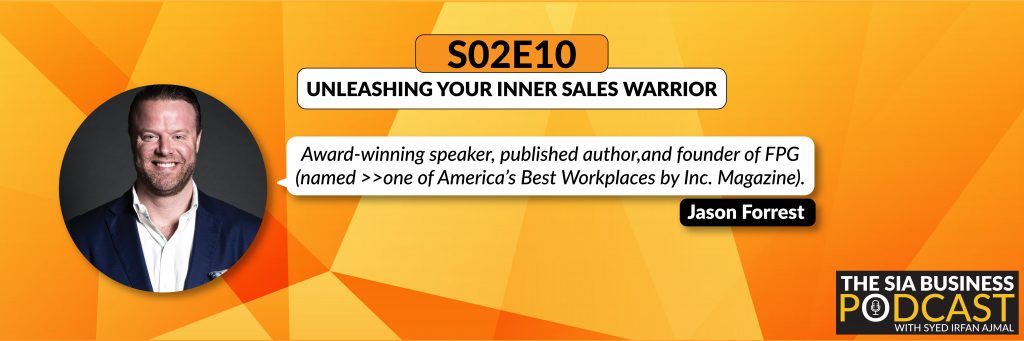
Jason Forrest on the psychology of high-performance selling.
§ 03Show notesVol. XV · № 03
§ 04Full transcriptVol. XV · № 04
Read Full Transcript ▼
Unknown Speaker 0:00
You're the average of the five podcast shows you listen to the most.
Learn to run your business well with the SI a business show where our hosts have their fun nuts most interviews, entrepreneurs, marketers and speakers of all colors and creeds revealing their biggest secrets and lousiest mistakes.
Hi everyone. This is
your host at the SI a business podcast. Our guest today is Jason forest. He is the CEO of forest performance group. It is a leadership and sales training company which was named as one of America's best workplaces for 2017 by none other
than ink magazine. Jason is also an award winning speaker and publish author he has in fact written quite a few books. He is also a certified NLP master practitioner. And he is on a mission to convince every person that they are enough that they are talented that they have everything they need to become successful. He does so by reprogramming their mindset so as to remove any mental blocks or mental leashes as Jason likes to call them. So any kind of mental blocks any kind of programming, which is holding those people back from becoming a better version of themselves. While studying Jason's profile online, I checked out some of his previous podcast interviews and training videos and I can assure our listeners that Jason's bold, unorthodox and game changing mental toughness strategies will surely leave an impact on you and they are going to impact your future growth and success.
Jason's most recent book, the mindset of a sales warrior contains 42 strategies that unleash human performance through transformational mental models. Last but not least, Jason has also built quite a bit of a following on social media. And he has over 1 million followers on Facebook. So let's talk to Jason and discuss sales, mindset training, writing and more.
Jason, welcome to the show. Thank you. I look forward to having a conversation with you, Sam here. So tell me a bit about yourself. Jason. I mean, why says as you often mentioned in your interviews and videos, it's unfortunately not the first choice of almost anyone so why sales? Well, let me think about it. The best salespeople are protectors of the customers interest as well as their advocates for the company's values.
They're serving and so you know there are really two problems in business there are sales problems and there are all the other problems and the biggest complaint that you hear from any entrepreneur or any business owner, I don't care how big or small you are, is that they need more profitable sales, they need… they need people to see the value in the product or service that they're presenting and they need more people to to choose it to buy it, you know. So to me, sales is everything. It's… it's the lifeblood of the world and so the problem is is that sales has always gotten a bad rap but that's just because… that's just because people aren't taught how to do it nobly, they're not taught how to do it ethically or with integrity or honestly and at the same time, you know, more people will have a sales job in their life than any other single job. So more people will have a sales job but yet less than 3% of colleges teach people how to sell successfully. So you know to me, there's this kind of perfect storm for, you know, no wonder why the consumer has a negative connotation around salespeople because we're not putting… we're not putting the education towards it yeah absolutely and do you agree that
To me, there's this kind of perfect storm for, you know, no wonder why the consumer has a negative connotation around salespeople because we're not putting, we're not putting the education towards it. Yeah, absolutely. And do you agree that I mean sales, even if one style is not officially, you know, salesperson or account manager or business developer, even then we are, we are doing sales in some form or another in our lives every single day, because we are trying to convince someone to do something, you know, whether it's convincing your wife to, you know, go to a specific location for vacations or whether, you know, convincing someone at your company why Plan A is better than plan D, right? That's correct. I mean, everyone is in sales. I mean that your kids are always trying to sell you on their ideas. A teacher is trying to sell a student on their ideas. A leader is trying to sell their employees on an idea. I mean, everyone is in sales in some form or fashion, because our definition of selling is to give certainty, plus education with rapport.
Well rapport is just be on the same page with someone. So knowing what specifically is their outcome? What is their goals? What are they trying to, you know, move towards? So what life improvement are they wanting to move towards? What pain are they trying to move away from? And then certainty is just giving people, you know, that emotional feeling of safety and security, that whatever you're selling is going to benefit them and help them achieve their goal. And the education is just the evidence to back up your claim. And so, you know, everyone needs that everyone, everyone's trying to find certainty. Everyone needs education to back it up. And we just have to do it again, learn how to do it with a noble fashion. Right, right. And I do agree that sales has unfortunately been getting a lot of bad rap over the years or even decades. One of my first jobs was actually in sales, and I was a corporate sales executive and I could not do it for longer than six months. This was way back when I just graduated in Sweden. And I think the kind of stuff
The reason I'm telling you this is that, I just wonder if you think that the kind of sales we were doing were the right kind of not. Because I was not happy with that, I do think that I also had my own problems, like not having enough confidence and you know, telling myself false stories and all that which I think you talk about in your book and your trainings and everything. But like, you know, to be very honest, we would be trying to deceive the gatekeepers of you know, top CEOs and marketing, you know, VPS, and all that of Fortune 1000 companies, we would, you know, tell them some kind of a story so as to get the phone number of the, you know, the top guys, and then we will go on that call. And another thing that we would do is that, you know, we would always be told to apply urgency, and that seemed very fake, you know, because if we were selling, you know, like corporate hospitality package for like a football tournament, which was, you know, one year away, and we kind of knew that this is fake. I mean, we actually knew that this is fake because, you know, we would be asked to tell that, oh, you know, just 10 packages are remaining.
And all that, and you have to sign up by the end of the day today. So you know, that's I think the reason I'm telling you is that I think that's fair, many people get this negative opinion about sales. Yeah, you're correct on that. And I'm Look, I don't know exactly how you guys were trained to do it. But the difference between persuasion and manipulation is intent. And so what's tough for people is that the same techniques that a person would use to sell someone or persuade someone to do something that would benefit them and benefit their company, you know, are the same techniques that someone would use to manipulate someone. The techniques are the same. The difference is the intent and so if…if…if you're, you know, if your company's…if you were told to do something before you really understood the customer's mission, what they were trying to accomplish, what goals they had, what pain they were [trying] to move away from, and it was, say anything you can possibly say to them.
Even if…even if you're lying to them, then obviously there's a manipulative quality to that. And so that's the tough part. But as far as, you know, giving them urgency, and those are all good things, as long as it's done with a positive intent. So I mean, is there a fair and authentic way of applying urgency without coming up with false numbers or, you know, wrong claims or something? Well, it would be just everything you just said, Just don't make it false. Right? So meaning that if you're going to tell someone just be ethical about it, and be honest and be truthful, and be transparent, I mean, that's what people are looking for. So the first book I wrote was called creating urgency. Yeah, non urgent housing market. This was back in 2008, when the housing market was an all time low. And it was a it was a best selling book at that time, because people you know, all the urgency came out of the housing market because prices were low and everything, you know, there's so much uncertainty in the marketplace. And so the whole concept the book was true urgency is emotional. It's the desire to improve one's life and people
will do anything to improve their life. And it doesn't matter how bad the economy is or how much uncertainty is out there. As long as they believe, their life will be better off they'll…they'll do something about it. Now…but I'm presupposing right now that people are going to be honest and truthful with their claims. Yeah, absolutely. And so…so I mean, that's the difference is that is that, you know, urgency, again, is all about getting people to believe that their life will be better if they make this decision. If they do this, something will change in their life for the better. Well, that…that's…that's urgenc…that's emotional urgency. But again, if you're doing that with false claims, you can still create urgency, you're just doing it unethically, or you could do it with true claims, and then you're doing it ethically. Yeah, absolutely. Yeah. You know, to give our listeners a more concrete example, like when you mentioned that, you know, in that book, you mentioned how to create urgency at a time and you know, there is an economic crisis going on and correct me if I'm wrong, what we might do what any sales person would do in that situation would be to
Stress upon the fact that, you know, the prices of the houses are at an all time low. And if you want to invest either to live in that house or you know, make a profit later on, this is the best time to invest because the prices are at the lowest right? Would you agree to that? That? That's correct. That's 100% correct. So that, you know, that's obviously giving people a true claim, and showing them the evidence, you know, to back it up. I mean, you know, for example, you're absolutely right. I mean, the, the true urgency in that case is that, you know, you get to buy a house at an all time low. And if your goal is to improve your life, then there's no better time to improve your life than right now. And at the same time, not only do you get to improve your life, you get to improve that life at a discount. I mean, that's a great deal. I mean, that will be better than than buying the house today. Because today that same houses, you know, probably 50 to 100% more expensive in some markets than it was back in 2008. So, so that's the difference. But again, when it's all said and done, though, you know, people will not procrastinate on life improvement.
And that's just human nature. You know, in the book, I talk about the idea of the six human needs psychology. And you know, people always have these basic needs of certainty, variety, which is fun and change. People need significance to feel important. They need love and connection to feel like they're connected to something bigger than themselves or family. They need to feel growth that they're improving, and they need have contribution to making a difference in the world. And so, you know, whenever you're working with a customer, the question is, is again, what certainty variety significance, love and connection growth and contribution? Are they trying to move towards, you know, what do they need right now that they currently don't have? And then what you would want to do is just become the missing need. So you want to show how your product and service can give them that certainty, variety, significance, love and connection, growth and contribution that they currently don't have and their product and service? And if you can do that, then then why would they not buy immediately. So that's urgency. Again, I'm presupposing, though that everyone
on the podcast right now would do that with integrity and with ethics and, you know, high moral standards. Yeah, I mean, absolutely. The reason I asked some of those more, you know, sensitive questions was just to make sure that any listeners who are on the call and you know, maybe are thinking, Okay, why am I listening to a sales related episode? I will continue to stay on this call. And, you know, find out why this is important. You know, what do you think about the kind of people who becomes ideal sales persons I know that you have conducted probably, you know, hundreds or even more trainings over the years in all of America, for salespeople of different organizations. So what kind of personality traits as restatements have always women? Well, what's interesting is I don't look at personality as much as I look at behavior. And so the problem with personality and all the personality assessments out there is it takes too big of a leap to show people's accuracy and sales. So for example, you know, the old school belief system was if someone is extroverted or outgoing,
Then therefore they would be successful in sales. And that's just not really true. That's taken a huge leap. That it just because I'm I'm outgoing means that, that I will also do the necessary work in order to make the sales calls in order to say the right things to the customer in the right order and have emotional intelligence…is just too big of a leap. And so what I look for instead is, whenever I'm looking for a salesperson or training salespeople, the thing that separates the top frome everone else is number one, do they have clear goal clarity? And so goal clarity is how clear are they on their target? So who specifically are they going to sell today? What's the customer profile? What…What's the certain customer in mind that they have? What's their name? their business, like be real clear on who that is? The second part of goal clarity is their strategy. So how specifically are they going to get in front of that customer? What's their process that they're going to follow? And then the third is their pursuit and so
that is will they take action? So people can know where they're going. They can know how to get there. But the question is, do they take action and do something about it? So that's goal clarity. The second quality is motivation. Motivation is the energy that a person has to achieve their goals. So for example, there's a lot of energy leaks out there. So you might have a salesperson who technically is in sales, but they've got a lot of energy leaks, meaning that they're thinking a lot about their paperwork or their CRM, or they're thinking about account management, or they're thinking about their family, or maybe they're going through a family crisis, or maybe they've got a side job, or they think about, you know, office politics and other things. So they have these energy leaks. And the problem is the best salespeople, they don't have energy leaks. They're very compartmentalised with their motivation. And so when they're in the moment of selling and they're making their outbound calls, and they're following up on customers, they use all of their energy towards the achievement of their goals. And then the third area
is there what I call their leashes, and their leashes are any of the resistance that holds them back from executing on what they know. And so there are four types of leashes that I described in the mindset of a sales warrior book. And I go through these 42 strategies on how to improve gold clarity, motivation and remove these four types of leashes. And so the first type is a story. And so a story is anything external from me that I believe is preventing me from selling. So they might say, well, we're in a bad economy, so people aren't buying right now or our competitors have a better product and so no one's gonna buy my product, or, you know, I can already tell the customers are interested based on body language. I mean, it's a story. Yeah, absolutely. Sorry to cut too short. I was just about to add that, you know, or a lot of the salespeople like, I mean, they like to say that, you know, if he could only offer better prices, you know, but surely price is not the only factor that should make the customers switch to you rather than the other guys, right? That's correct. And so if I was coaching a salesperson, we'd
A lot of coaching, the big thing that separates from everyone else and why we won all these awards, is we spent a lot of time removing the mental leashes that hold people back. So if I was to coach a salesperson, and they were to say, you know what, we just don't have the right price. And I would say, Okay, well, how many prospects right now? Do you feel like you've been the last out of the last 10 prospects? How many of you feel like you've lost because you haven't had the right price? And they say, let's go through some, you know, five of them. Okay, so, so you've lost five, because you haven't had the right price. So what price specifically do you, you know, do you feel like you need and, you know, 10%, less 15% less? And then you say, Okay, great. So right now, sure, I'll give you a 10% less price. But here's the deal. You have to guarantee me, and you have to put your entire job on the line that if you go offer him a 10% discount that they will buy and if one single one of those five doesn't say yes, then you and I both have to agree that it's not a price thing. It's something else. Are you willing to put your job on the line that if you cannot convince all five of those
To say yes, then I will accept your resignation. And so the reason why I'm doing that is, it sounds like a tough question, but I'm doing it because I want to put the locus of control back on the salesperson. And so what's happening right now is the their locus of control is outside of them. And they think the reason why they're not successful is because of something outside of them. And so I want to put it back on them that they need to take full responsibility over their success. And again, hundred percent of time, the salesperson will say, Well, I'm not I'm not willing to put my job on the line. Okay, so the government your job in the line, then is it possible it's something else besides price? Well, I guess it's possible. Okay. Well, let's talk about those things. And so that's an important thing. Again, it's a tough question. But you know, to me, the best thing I can do to serve the human race, is to get them to believe that if they succeed, or they fail, it's all on them. And every human being is simply that not just a salesperson, but that it's all everything is in a person's control, guarded. So that's the first leash that people often
Have expedience to the stories that they tell themselves? What are the other three? Perfect. So number one is stories. Number two is self image. And so self images, I don't see myself as a salesperson, I don't see that I'm capable of doing these things I'm not I don't have the necessary talent or capabilities to pull this off. That's not who I am. You know, I defined myself as an account manager or a business development manager or a customer relationship manager or, you know, a financial advisor or realtor, I'm not a salesperson, well, that's an identity thing. And identity is a big deal. And so, again, I'm one of 2000 people in the world. It's a mash practitioner and neuro linguistic programming. And identity is a big deal in the sense that the difference in beliefs and identities is a belief is something that we think to be true over and over again. So it's a thought that we have over and over again forms our beliefs. Well, an identity is something that I was to ask a person Well, how long have you believed that? And they say something like
I just believed it my whole life. I don't I don't know when that belief started, well, that's an identity. That's an identity. And so what we have to do in that case, we have to get them to see themselves differently or, you know, an easier one to do on the self image. One would be, they don't see themselves as worthy, or they don't see again, that they're capable of doing that. And so I have to help them recognize that they have a growth mindset versus a fixed mindset and that anyone can learn how to sell. And it's interesting because people go, Well, I don't know if that's true, Jason, because I think some people can do it and some people can't. And that's okay. Well give me give me an example of someone, they'll say, Well, my daughter, you know, she 35 years old, she's very kind of quiet and so forth. There's no way she could ever sell anything. And I said, Okay, well, I'm gonna go back to your daughter when she was like five or six or seven. Okay, well, how good was she at convincing you to stay up late? Or to have a dessert when you said no to her? Or to buy a toy or candy after you said no? Yeah, she was pretty good at that. Okay, well, then she knows how to sell
She's been doing it since she was born. It's just some time along the way. She was told not to do it and her identity was formed that she's not capable of it. And that's, that's a big thing for everyone to write down on how much that changes things. Because if you think about when someone's having, let's say, a bad mood, you know, and they seem kind of angry, you know, you would say, Okay, well, that's a mood there, and they're having a mood right now, and it's a couple of days aren't a mood, well, then all of a sudden, that mood that bad that angriness turns into, you know, maybe several weeks, or several months, maybe a year, well, all of a sudden, we'll say, okay, that's a person's personality, temperament. That's their temperament. They have a temperament of being angry. Well, if that temperament lasts for several years, it will turn into their personality. Right. That's interesting, right? Yeah, absolutely. So So personality, that's why personality is a very slippery slope. We got to be very careful when we lock onto personality because again, we lock on a personality. We're presupposing that that's fixed.
That that's who we are at our very core. And I just don't believe that I believe that, that everyone is enough and everyone is capable of doing anything they want to do in their life, if they want it bad enough, and if they're willing to do the work to change. Yeah, absolutely. I do agree with you on that. And I would like you to mention the other two leashes as well. But just to clarify my point. So for instance, let's say there is a company out there, and they know that they might need to hire, you know, a company like FPG for training their salespeople, and, you know, improving their behaviors or changing the behaviors, right. But what do they need to do to hire the best people that are out there who need the least nudge to change their behavior? Does that make sense? Well, from understand this question correctly, you're saying, are we saying what do we need to do to find those people or what do we need to do to change their behavior? Sure. You know, my original question was, what are the ideal personality types or personality traits, for instance, for anyone to become a great salesperson right now, you said
And rightly so that you know, we shouldn't be focusing on the personality traits and that kind of things because anyone can learn sales, anyone can become a sales expert. But what I'm saying is that for instance, if I want to work with FPG, right, to improve the sales performance of our sales team, what kind of people should I hire so that it's easier to get them changed to a company like FPG. So, again, yeah, so people you need to hire people who are highly goal oriented, highly motivated and unleashed. And I would also say procedural based, so those would be the four qualities that I would I would look for. So if you look at going back to the four types of leashes, so can you have stories self image, the third one is a reluctance and reluctance is nothing more than a fear. And we have an assessment that that we can offer people to figure out their levels of reluctance there are 16 different types of reluctance is stage fright, you know, asking for the person to purchase taking control of the sale.
selling the upmarket clientele like the C suite, friends and family selling there's different reluctance is that people have. And so we can give it to us give people an assessment that can show them which one they have, then we have workshops and programs to remove those those reluctance is. And then the fourth type of leash is a rule. And a rule is anything I need to see feel or hear. That gives myself permission to engage and to move forward. So for example, you know, the, again, this is really outdated, and it's really horrible that people are taught this stuff, but they're taught stuff like look for buying signals. So for example, if a person is smiling, they must be interested, if they're asking questions, they must be interested. Well, you got to be really careful with that stuff. Because Because I, you know, there's a lot of people that have bought that aren't very happy that are that, that don't smile. I mean, I know a lot of C level executives that just don't smile. They're just very serious type people. And so if you're waiting for them to smile, you're going to lose a sale or if you're waiting for them to ask questions, you're gonna lose a sale so you'll be really careful about that.
These different rules, you know, that that we put into play, you know, I, I must follow up with the buyer five times before I can ask them to buy I mean, come on, like Has anyone sold someone by not doing that? I mean, so be careful those rules. And then the last is procedural based, which you were talking, you said what are the four kind of traits. And procedural means that I'm a salesperson that's disciplined enough to follow a specific process. So this is what's called a meta program. So the way that our brains work, we have different kind of meta programs. And people are either optional based or procedural based. And so think of an optional basis. every customer is different. It depends on the situation. I really go with the flow of things I need to kind of figure it out person by person, a procedural based mindset person in anything, is I follow a very disciplined process. And every time I follow it, the sale happens or the score takes care of itself. And you know, the most successful companies are very procedural based. You look like chick fil a or Southwest Airlines.
I mean, they're all very procedural based. They don't, they don't change things very often. And they follow a certain set of steps in order to make make success happen. And so again, those are the four traits, the highly goal oriented, motivated to focus and prospect unleashed. And then procedural based or the fourth, I look for Gordon, and in terms of people who, you know, companies which follow strict procedure, don't you think that it kind of kills the creativity and innovation as well? I mean, that that would definitely be the debate on the other side, right. So, you know, I don't see it that way. I mean, my argument to that would be that the best artist have a foundation of science. So the reason why Michelangelo was able to create the David statue, this perfect specimen of the human body was because he was a scientist first. If he did not understand human anatomy and follow the process of creating great art, you would have never had that we wouldn't
ever known who Michelangelo is. And so there's not a I mean, you know, Richard Branson would be considered a great artist, Elon Musk could be considered great artists, but they're scientists first. And so my opinion is, I think great creativity comes from a foundation of great science. And that's true. I mean, look, my son Saunders, you know, he is 11 years old, and he, you know, loves music and wants to, you know, play the piano, but I can't get the kid to focus on learning the keys on how to play the piano. He just wants to be creative and make up his own songs. Well, his song sound like crap, let's because he won't learn how to play the piano. He won't learn the keys and what music is supposed to sound like, Well, once he learns that, or if he has the motivation to do that, well, then he can be liberated to create his own art. But you can't create your own art until you have a foundation of great structure and science. Yeah, that is an excellent example. Because I mean, it's like knowing the rules and having that foundation before you go on to try something different.
You know, sound crazy or you know, which is kind of innovative or unorthodox, right? Well into further provide evidence for that, you know that over 90% of all businesses, all entrepreneurs are artists, more than integrators. But the reason why majority of those businesses do not make it to a million dollar a year business or higher is because they don't have an integrator. They don't relinquish the control to an operations person to to create systems and processes to scale their art. And so I mean that it's an interesting thing, majority of business owners would be more on the artist side. But the reason why majority of businesses fail is because they don't create procedures to scale their art. That's a very interesting statistic. And we at our agency have been focusing more on the processes side I have yet to found an integrator, but I have been following the traction ox model the entrepreneurial operator
system. Have you heard of it? Yeah, of course. And so you know, the idea that I'm talking about here because that's a stat from traction and their sequel book called rocket fuel. The whole idea of a visionary and an integrator I, I kind of blend them all together because I've read scaling up and traction and good degrade and great by choice. And then Tony Robbins, business mastery where, you know, he so I kind of kind of blend them all together. And I use the term artists and integrator, more so than visionary and integrator. And so, in our company, what we do, and again, we were the fastest growing sales training company based on Inc for last four years and the best place to work for or out of 80,000 companies last four years. And what we do is we label people, the organization that you're either an artist or an integrator. So for example, every artist in our company has an integrator that helps them, you know, or think of it like is, you know, if you're a fighter pilot, you've got the pilot and you've got the navigator, you know, and you in Top Gun, you've got Maverick and goose, and that's the idea is that you need an artist. Every artist has to have an integrator, and so a salesperson for
Example. Like our entire sales team, they all have integrator support. So I just want them making phone calls. I want them pitching. I want them, you know, learning about the customer, but but they have integrator support that keeps their their pipeline full and their CRM fall. And so every morning, the integrators job is to make sure before the interview goes to bed that night, is to plan for the next day, who the salesperson is going to call. So that's there, the navigator I mean, that they're the navigator of my sales team. And same thing with our training department, our consulting department, my trainers are focused solely on training, teaching and learning how to be better for their clients. They don't book their own travel, they don't they don't organize things. We have an integrator support team that tells them the order of the training that the client supposed to go through and you know, they just show up and do their job. Yeah, that sounds very interesting. And I hope to have you again on the podcast show some time to talk more about that. You mentioned reluctance and that's something which is very interesting because
One of the reluctance I experienced while speaking to a warm lead is, you know, finding out how to qualify them. You know, I feel that that hesitancy and shyness, so what should I do in that sort of situation while qualifying a sales lead? Well, what I teach in, in our process of cold warrior selling, and we've got, we teach the idea of you want to categorize the buyer, and we categorize the buyer with a series of questions. So the first question you would categorize them with, as you say, Great, so based upon your current situation of wanting to do blank and wanting to stop doing blank, have you definitely decided to make a change? And they're either going to say yes or no to that. And if they say, Yes, we definitely have to be different, well, then now they're what's called a category two, and then a category two buyers, someone who's definitely gonna make a change, but they're overwhelmed with all the options. And so for them, you want to narrow it down for them. And then a category three is someone who is torn between, you know, a couple of different options with you or you and a competitor, but they're definitely going to do something and so you have to kind of
To help them through that process and get them to a point of resolution and compromise. And so, you know, when I would kind of change the question from qualifying to categorizing, because I think it's easier. But you know, to me, once you've learned how to ask the question, which is, have, you definitely decided that you're going to make a change, but you still feel reluctant to ask that question. You know, I would, I mean, there's several things that we can teach you to deal with that are taught in the book. But, you know, one, one is a very simple concept. And that is, what's the worst thing that's going to happen? If you ask them that question. Yeah. And then, you know, your response could be, well, I think that there, they might get offended by that. Okay, well, what what would cause you to believe they would be offended by that? You know, what's their goal? What's their intention? Well, their intention is, the customer's intention is they want to speed up their business. They know all businesses desire, speed and profitability, all of them. I mean, every business owner, every everyone is trying to increase speed and profitability in our organization. And so we know that to be true. And so you know,
By asking the customer, you know, have you decided to make a change? All you're doing is clarifying where their ambiguity, lies. And ambiguity is the most crippling disease of the human race, people are constantly procrastinating to being stuck. And they're putting off their own life improvement. And the more they put it off, the more they can't be like proven or their competition is going to, you know, it's going to take them out. And so, you know, I just feel like it's very honorable and noble to ask a person a question that gets them unstuck or clarifies where the resistance is. And then you know, so that, so I just would, I would kind of that was to coach you, I would do a lot of questioning with you. Because the more you question, a limiting belief, the more you weaken it. Yeah, yeah, that makes total sense. Does that make sense? Yeah, absolutely. So how does high ticket sales differ than you know, more economical items? Is it natural, for instance, to expect that the sales cycle for you know a six figure project or product or something is going to be way longer than a much cheaper project for instance, or product. I mean, it just
Depends on on where the leash is coming from. So it is a more expensive product or service that you're selling, could it possibly take longer? It could, but that's because there are more people involved in the process that you have to get to, and you have to sell multiple stakeholders, right? So that's really where the kind of the dilemma lies is that, you know, if you're selling to one person, then you're just having to take that one person through the process. But if you're having to sell to a committee, you know, we're having to sell one to the, you know, some sort of assistant that's getting information, you have to convince them and you have to get them on board. You have to categorize them and then you get them to the point of getting you in front of the next person and then then you have to categorize that person and so, so that's the only difference is that it requires you to treat every person in front of you almost like a new sale. And that's, that, by the way is a huge thing. I want everyone to pay attention to the big mistake that a lot of salespeople make when they're doing the complex sale.
Selling multiple stakeholders is they go, you know, what if I can't talk to the one who can make a decision, I won't even try? Well, that's just dumb if you think about it, because you're gonna miss so many opportunities, because it's, it's nearly impossible and a lot of cases to get directly in front of the main decision maker out of the gate. And so my whole thing is, whomever I can talk to is my customer, whomever I can, I don't care if they're an entry level person that has zero authority whatsoever. They've got some sort of influence. Yeah. And so my job is to convince them that they're willing to put me in front of the next person in charge. And so I'm going to sell that person, it's going to keep selling up the chain of command until I get to the one that can you know, they can afford me. The last thing I'll say, from an advice perspective on on selling, even though this book is all about mindset here, so this is more, we have a different concept around process. But the other mistake people make when they're selling to businesses, is you need to sell the most you can
To the person in front of you. So for example, a lot of people have some, you know, I don't know, several hundred thousand dollar product or service, but the person in front of you only has spending power only has a budget, let's say that's $25,000, without without any other approval, they can spend 25 grand, that's it? Well, you come in guns blazing with a $200,000 product or service? Well, you got to get through several layers before you can sell them anything. And so the by the time you get to the final person that can decide that people can be turned over, you could have lost the person in front of you, versus if you sell to the person in front of you. What now you're inside the company, right? You know, you sell them something inside when you're inside the company. Well, now you're a vendor. Now you've got you know, an account inside of them and then you can of course upsell to higher levels. So that's a big tip that I would recommend that people make mistakes, they just sell the most you can the person in front of you. Yeah, that's an excellent tip. So like, you know, not focusing on just the biggest or the most premium stuff.
It's a product but also having upsells downsells. cross sell options, right? Correct. Yeah. So again, it's about finding out, you know, after you have rapport with them and understand what their goals are, you need to, at some point find out what spending authority Do they have. So what spending authority Do they have, and every employee has a certain spending authority level without running it by someone else. And you really just got to look at it as well, I need to do my best to tailor a product or service to their spending level. And if I can get them to, you know, to use that budget today without having get prior approval, then now I'm in the company, and now I can, I can do anything after that. So that's a big, you know, a big thing and for everyone listening right now, you know, we've the mindset of a sales warrior book, we are offering it for free all people to just pay shipping and handling. So if they go to warrior mindset, book calm, then they can get the book for free. We'll send it to them immediately and get access to the ebook. They just had to pay shipping handling which is like 10 bucks or less and but then on top of that,
There's all kinds of other offers in there like an audiobook and meditations and hypnosis. There's a leash assessment, there's all kinds of coaching that I do is all kinds of things, they can also get in there as well. That's awesome. In terms of training, I hope you still have a few minutes because I do have a few more questions as long as you want to talk. Sounds good. So uh, regarding your, you know, the trainings that you guys offer, is it like an event based thing where, you know, people come and they, you know, attend a two day event, and then you know, they go back to their lives where, you know, everything is still the same, and then they go back to doing things the way they're used to doing? That's a great question. So when I started my company nine years ago, what I did is I looked up the definition of training. And and I was a corporate trainer before that, and, and the definition of training is to change behavior. And I couldn't find one single example of a training company that had that had evidence that they could change behavior, but there are hundreds of thousands of individual human beings out there that call themselves trainers.
And, you know, thousands of companies that call themselves training companies. And so what I decided to do was figure out how do you train change behavior? Well, the previous book that I wrote is called WTF, which stands for why training fails. And it's 164 billion is spent every year on training, but 70% fails, reaches ROI. And so I wrote a book on how he became in the 30%, and how we've sustained that. And so one of the key factors is learning is a through time process. Importantly, we will write down learning as a through time process. So for example, if you were to go to that one day event, well, within a couple of days, you're gonna forget everything that you've just learned. And so we learn best through experiences. Like, for example, if everyone was to get on a plane right now, and all of a sudden over the loudspeaker, someone said, Hey, this is Jason from Southwest Airlines, and I just went through a two day event and where I got certified on how to fly a plane and I know exactly how to do this and you guys just buckle up for safety is my first flight. You guys will all get off the plane right? Which is nuts.
So, you know, to learn how to fly a plane, there's a through time process. I mean, they, they have, you know, thousands of hours or they have to be in flight simulators and have a flight instructor and, and they have ongoing certifications and training. And, you know, and so that's how we have to look at anything and, and specifically, I focus on sales and I focus on leadership. We've got several programs on executive leadership and coaching and managing. But everything we do is a program based approach, not an event based approach. We will not take on a client if they if they hire us for events, we'll do a event to get them to understand what we're doing and to see the value in it. But but we don't have any event based clients, we only have program based clients. So how does the programs look like? I mean, is it all taking place in a physical location? Is it like, you know, video lectures or webinars? Sure. So the combination is, number one, there's assessments, so we always need to kind of assess where we are and our mindset and our behaviors and our beliefs. And so that's number one is assessment number two is there is
Some sort of seminar or event workshops that kickoff the ideas. And then number three is that they watch a video every week that takes the learning and chunks it down into something specific and behavioral that they can do, you know, that weekly basis. And they practice that internally. They're coached on it by their manager. And then they get on a zoom call, where they can practice it and specifically talk about real life situation. So what's different about us is that if you were to get on one of our follow up zoom calls, it's not just talking theory about Hey, would you go to the lesson? What do you think about it, we don't do that. What we do is, let's talk specifically about a customer that you're working. And let's talk about how to apply this technique and let's get you prepared. So when you call the customer up, you know exactly how to move the sale forward. So ours is very tactical, and it's very specific. And and so because of that, we have clients like yesterday, I was talking to a client that their sales are up 35% year over year, in a very down market, and they're
industry and they're in big commercial $250,000 commercial machines and with less people, and he told me that that my company only spends a couple hours a week with their their sales team. But he said he would double it because we're most people think it's a waste of their time to be on a training call. He said, Every time my my salespeople are on this calls with your training team, our sales immediately move forward. Like we get immediate success off of those calls on a weekly basis, which is what I mean, what's what people are paying for, right? They're not paying for a book study, you're paying to improve. Right, right. That's very good. So what are some key tools that you and your team use during workshops or seminars or do zoom calls to you know, keep everyone entertained and engaged? You did mention, you know, about talking about, you know, like, I guess it's kind of role playing that you mentioned that, you know, okay, let's practice this says problem that you have, how are you going to speak to them, but is there anything else that you guys do? Well, I mean, so the big thing that we like to describe ourselves as we are a house
based training company, not a what and why based training company? So for example, here's a cool thing for everyone to think about is when you were a kid, how many times did your parents or teachers tell you to pay focus more, concentrate more? Pay attention? We'd all the time, you know, parents are telling that to their kids. But then you ask the same audience, how often did your teachers or parents tell you how to focus? How to concentrate? How you know they never will. The same thing goes with most training companies and most managers and if we ask a manager, how often do you tell your salespeople that they've got to sell more all the time? How often you tell them they should ask better questions to understand the customer's needs all the time. How often you tell them to a sell value all the time. How do you tell them to Did you ask person to buy clothes more all the time? When was the last time you told them how to do that? Yeah, yeah. And and this also crickets. Yeah, absolutely. And this also connects to your you know idea about the leashes and
The stories that we tell ourselves, I mean, if I'm not focusing on what I can do and how I can do it, and how I can do it better, and instead I'm focusing on, you know, some external things that I cannot control or, or some kind of self image issues that I have that I keep, you know, telling myself in my mind and everything, then you know, that's only increasing the problem, right? It's not solving anything. That's correct. Yeah, that's correct. So, what we have to do, though, is again, the formula that we created, that's a very trademark formula now is performance equals knowledge minus leashes. And so performance is what a person does, that's their performance. Knowledge is what they've been asked to do, or taught to do. And a leash is anything that's preventing them from doing it. So let's say we teach a salesperson, hey, you need to so first you got to give them the knowledge. So we teach them, hey, ask the customer what's holding them back from choosing you? Great question. You learn a lot of information from it. You figure out where their ambiguity lies. Therefore you can handle the concerns. Give them certainty with the so forth.
Okay, so I feel I get it pretty simple question. What's stopping you from asking that question? That's a great coaching question. What's stopping you from asking that question? Well, then you're going to identify one of the leashes and it could be a story or they say, Well, I can just tell you right now, they're not going to buy because, you know, they, they just, it's a tough economy and, you know, it's just, they're just not gonna buy right now. Or they're gonna, they said they're gonna wait until the next budget cycle before they can do anything. Okay, story self image. I don't know. I just don't feel like asking that question. I don't feel like I it's really kind of the kind of question I feel comfortable asking doesn't feel authentic. To me. That would be self image, the reluctance would be I feel like I'm gonna come across too pushy. And too salesy. If I asked that question, so I'm just going to ask it, or it could be a rule. And that is, well, I really need to, I feel like I need to earn the right to ask that question. And I really need to, you know, spend more time with them. And I was only able to spend like 1520 minutes with them, you know, when they had to get off the phone. And so I just I don't I need to spend at least 45 minutes where I can ask that question. There'll be a rule, right. So I would figure out
First, I asked him the question, what's stopping you from asking that question? And then I would identify it's a story, self image, reluctance or rule. And then from there, we would do the necessary practices to get them to see that differently. Right, right. You did mention meditation, and I believe mp3 audio clips or something like that. So do you think that to be in that right state of mind set? Because we cannot be hundred percent motivated every single day? Right? I mean, are there any kind of rituals that you do or that you suggest your clients to do in order to be in the best state of mind for you know, peak performance? Why I believe a person could be 100% motivated 100% of the time, I don't know why they couldn't as long as they're doing the necessary practices. Now, the reason why they're not motivated is because of something of how they started their day, or they're not doing the necessary practice. But I wake up every morning at 430. And I have specific rituals that I do to get myself in a certain frame of mind. I mean, so just the cool thing you're going to learn right now is that you know, we have two parts of our brain we've got our conscious mind.
our subconscious mind will our conscious mind is about 5% of our thoughts. Sorry decisions come from our conscious mind. 95% come from our subconscious mind. Well, if you're not achieving the goals that you want out of your conscious mind, well, that's because your subconscious mind is in congruent with that. And about 70% of our programming happens in our subconscious mind by the age of seven. And that's why the co founder of the Jesuits would say that give me a child for seven years, I'll never leave the church. And so the reason why we are constantly not achieving our goals, or we have these leashes is or we're lack motivation, or whatever that is, it's because something in our subconscious mind is holding us back. So an easy way to look at that is whatever you think about like the cloud in today's computing systems, right? So whatever you upload into your cloud, you download into your reality. Whatever you upload into your cloud, you download into your reality. And so what I'm constantly doing is reprogramming my harddrive. My mental computer, my subconscious
To make sure that I'm uploading the right things, the most productive things that I want to do that day, I'm uploading that into my cloud in the morning through rituals and the night hypnosis, and meditations so that I can download that into my reality. So you can start that with daily practices. And there's a lot of science to prove that I mean, when you're first waking up, you're in usually a theta stage, which the transformational stage is when your subconscious is most susceptible to programming and then alpha which is light trance, and then you know, beta, which is I consider that to be beast mode or baller mode. And but you the best programming happens before you go to bed at night, or when you're waking up in the morning. And so you can do that through, you know, different meditation tracks and I have those I have those for salespeople. That's one of my certifications is in hypnosis. That's very nice, very interesting. Now, you know your company FPG was termed as one of the best places in America to work at right by ink magazine.
So, was that an accident? Or was that plan any tips for any business owners out there who want to create, you know, ideal workplaces? I mean, everything has to be intentional, you know that people all the time Tell me, you know, I really want a great culture and or they'll say, you know, I don't have a culture, Jason like everyone has a culture of it just might not be intentional for you. But you have a goal or a promise. And a culture is nothing more than my definition of culture is what happens behind the boss's back. And so meaning that if the owner of the company or the sales manager, or the CEO, or whomever is in charge of that department or that company, if they're right next to the employee, what are they doing? How are they operating? Why assume they're doing everything you'd want them to do? Well, when you're not around, what are they doing? Well, if they're doing the same thing, when you're not around is when you are around, that's the culture you want, if they're doing different things, when you're not around, that are unproductive and not what you want them to do. And that's a culture you don't want and so you just have to be very intentional about doing that. And so we also do a lot of psychology.
In our culture, give people purpose we give people meaning, you know, we focus our culture a lot are on the six human needs. So how does our culture give them certainty, safety, variety, fun, significance, make them feel important. love and connection growth, they feel like they're improving contribution, they make a difference in the world, they have purpose and higher meaning. And so, you know, we're really big on that. And, you know, the big thing. I mean, I'm always I've interviewed, we've won the last four years in a row for Best Place to Work in Fort Worth. And people always ask me like, yeah, so they asked me a lot, you know about this concept. And I just tell people, look, the first thing is, you know, we're a Best Place to Work for people who want to be a part of our culture. So we hire, you know, we're very transparent with the kind of culture we have, and we hire for that. At the same time, we're very clear for people very clear that if you are detracting from this culture, and you don't be a part of this culture, then we don't want you here either. So we're very hardcore on that. So we're a lot of people will just kind of tolerate a lot of companies will just tolerate the
People who don't want to work there. I mean, we had, we had a story one time that was a high producer, high producing marketing person. And we were doing a quarterly meeting and had a dinner and we were all going out to go bowling and have dinner and so forth. And she was overheard by one of her peers telling her husband that she has to go to this dumb company, party and outing tonight. Well, her peers came to the President, the company, Mary Marshall ratted her out and said, here's what she said immediately. She was brought into Mary's office and Mary let her go that day. She was a high producer too. But we said we don't care. You weren't you will not be you will not be a virus in our culture. And I don't care how successful you are in this place. We're looking for successful doing the right things and wanting to be a part of this place. And that's, you know, what we spend majority of our life with people that work majority of our life, people that work. Yeah, and so that's the reason why I created a culture like this is I spend more time with these people than I do. I do. My friends, you know, are my kids and so I
I want to be around people that want to be around. And I think most people want to be this the same thing. Yeah, I mean, it shouldn't be a place which, you know, the employees are afraid of going to or are not excited about, right? It should be something that they wake up in the morning, they say, Okay, I have to go there. And I have these, you know, lovely friends or colleagues. And I'm going to be there. And Dave will be supporting me and I will be supporting them and we are going to do something great together. Yeah, correct. And that's the whole idea is you want to have a culture where people want to be there versus have to be there. And again, we're very clear with that. We tell people all the time, if you do not want to be here, then that's okay. We want you to be transparent, honest with us. And we will give you grace and we will help you find a better job and we will refer you to a better fit that you would like to be a part of now, if you don't want to be here and it affects your work performance. And it starts to show your work performance then you will be let go. But if you don't want to be here, go ahead and tell us as early as possible and we will do the right thing for you.
We will help you find a better place to work. That seems quite fair. So speaking about workplace culture, Jason, we are going to wrap this up in just a couple of minutes. But do you have any favorite books or podcasts or any of the material on creating that excellent culture, the kind that you have, and which has caught you guys so much recognition for you? And that's a great question. It is fun by Google's I mean, Patrick, yeah, go on. Sorry. I mean, those are all great. I mean, definitely. I mean, I think the best thing to do is think about who are great, who are considered to be great cultures. I mean, Google, you know, the best places to work in America. And, you know, I would check them out. I mean, 100 got junk is a great culture. I've been told, you know, container stores a great culture. Google, supposedly, is a great culture. I mean, so I would just, I would check into them. I mean, also, the work by Patrick lencioni. You know, he's got a lot of books on culture. He's got one called the advantage and there's a lot of, we've got programs and we've got a program called executive playbook. That will measure the impact of it's an assessment amazing assessment is one the most innovative leadership
NOAA program in the world by Stevie award last year, and it was where we will measure VDP. And make sure to include its link in the show notes as well. Yeah, perfect. Yeah. So it will measure the impact. It will measure the culture that you currently have, it'll measure the impact of your leadership team. And then there, there's a it's a 15 lesson program that's done two lessons a month, with assessments and workshops, and so forth on working with the leaders to show them how to be better legacy based leaders and to become a leader that people want to follow. And it's very evidence based, and it's very, you know, tactical. Sounds good. And any books that you can suggest on the art of selling or you know, behavior change and having the right mindset? Well, that would be my book, the mindset of a sales warrior. So, absolutely, I mean, so what I did is just in case everyone wants to know, I mean, I kind of did the work for everyone. So when you read my book, in the book, I, you know, I refer to Carol Dweck work on growth mindset, which is a book I refer to daily
coil and the book talent code. I mean, there's so many books that I talk about and when it comes to habits, and so I've read a ton of books, on their philosophies on how to change behavior. And then I took those, and I put them as individual strategies inside the book. So my book, kind of like an executive summary of about 100 other books on behavioral change. That's awesome. And I will definitely be ordering my copy pretty soon. This is it for today. Jason, thank you so much for being on the show. I know that I took a lot of your time, but I hope that you enjoyed this as much as I did. I'm sure that our listeners are going to learn so much about sales and mindset and everything else that you talked about, what's the best way for people to get in touch with you? The best way again, is to go to either FPGA comm so FPG stands for force performance group, and that's our training company. They definitely can get a hold of me there. Also, they go to the warrior mindset. book.com is where they can get a copy of the book, or Jason for us.
dot CEO is my personal speaker page. But I really encourage everyone to check out the book warrior mindset book calm and again, check out the meditations, hypnosis and I really do some cool stuff in there about getting inside of people's subconscious mind and helping them remove the leashes that are holding them back from from earning what they're truly worth. And, you know, I've never met a single human being when I've asked him the question, you know, are you earning what you're truly worth? Not one single person ever told me? Yep, earning money truly worth it. Everyone's worth more. Everyone's capable of more. Absolutely. Thank you so much, Jason, and I look forward to having you on the show. Again.
Thank you for listening. For show notes and other resources. Please refer to the description of the show.
The podcast you just heard was made using anchor, ever thought about making your own podcast, anchor makes it really easy for anyone to get started. It's a one time
stop shop for recording, hosting and distributing podcasts. Best of all, it's 100% free, sign up now@anchor.fm slash new that's anchor.fm slash new to get started.