§ 01Listen · Watch · SubscribeVol. XV · № 01
§ 02About this episodeVol. XV · № 02
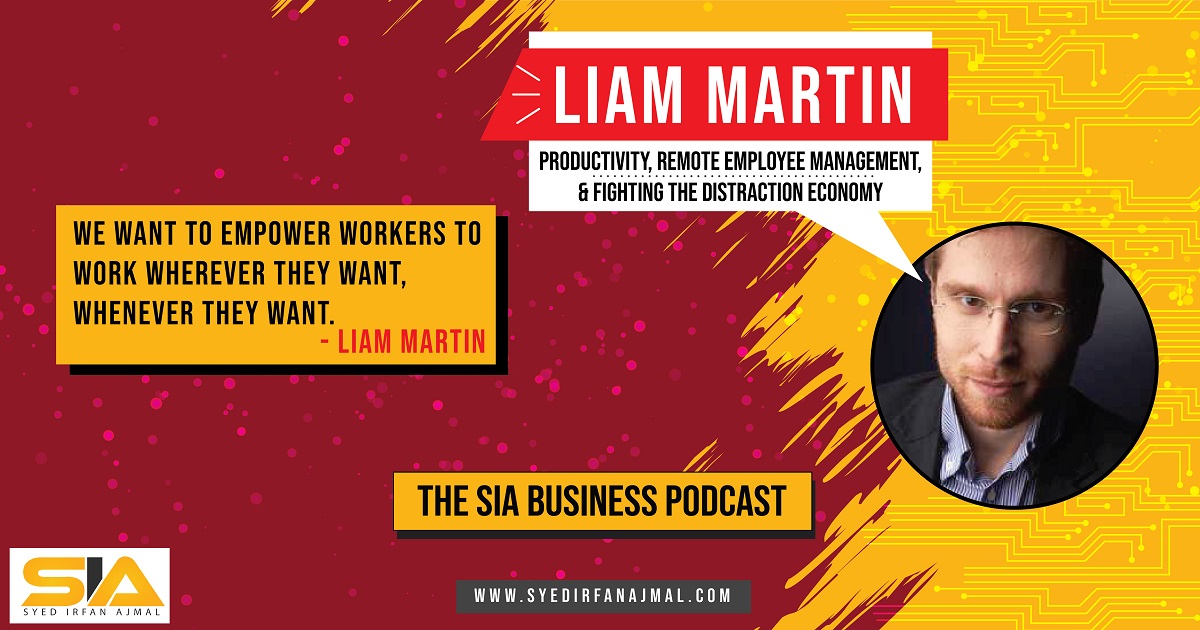
Liam Martin, co-founder of Time Doctor and one of the world's foremost experts on remote work, on productivity systems, managing distributed teams, and fighting the distraction economy.
§ 03Show notesVol. XV · № 03
§ 04Full transcriptVol. XV · № 04
Read Full Transcript ▼
INTRO: (00:01) You're the average of the five podcast shows you listen to the most. Learn to run your business well with the SIA Business Show, where our host, Sayed Irfan Ajmal, interviews entrepreneurs, marketers, and speakers of all colors and creeds, revealing their biggest secrets and lousiest mistakes.
Irfan: (00:25) Hi everyone. We have a very special guest today in our show. His name is Liam Martin, and I will let him tell you who he is, where he's from, and why he is here. Welcome, Liam.
Liam Martin: (00:37) Thank you for having me, Sayed. Well, who am I? My name is Liam Martin. Why am I here? I am here to chat with Sayed and talk about our three companies Time Doctor, Staff.com, and our conference that we're running into June called Running Remote where we're putting smartest people that we could possibly find in a room and figuring out how to build large scale, remote teams.
Irfan: (01:01) Wonderful. Wonderful. Thank you so much, Liam, for taking out the time for this episode of ours, and I'm sure we are going to have a very nice chat with you. I also have… as part of my research for this episode, I have gone through some of the previous podcasts interviews, and I learned a lot, but the good news is that I also got more questions.
(01:18) So Liam, tell me a bit about yourself before you started with the Staff.com and Time Doctor, maybe when you were graduating and what was it like? Did you always want to be an entrepreneur? Was it something that sort of happened due to, quote-unquote, accident?
Liam: (01:33) It was something that I always wanted to do, but for a certain part of my life, I didn't recognize… I was not sure whether I wanted to do it or I was pretending that that wasn't who I was.
Irfan: (01:48) Right, right.
Liam (01:49) So like, I'll give you an example. I was in grad school at Mcgill University, finishing off graduate school there and really wanting to teach. That's what I wanted to do. My degrees are in Sociology. So, I really wanted to pursue that long term.
(02:04) And I remember teaching my very first class and up until that point, I had been a TA for six, seven years, but this was the first class that I was able to teach, and it was a disaster. I started with 300 students and ended with about 150, and it was a horrible experience for both me and the students. And I remember walking into my supervisor's office and just saying, I don't think I'm very good at this.
(02:27) And he said, "No, you're not. You're not very good at it at all. I think we need to figure something else for you to do because you either need to get much better at teaching or you need to figure out another plan." And so, I ended up getting completely out of that and back into entrepreneurship. And I had actually sold the business to fund graduate school.
(02:49) So, I was already in the entrepreneurial mindset before I went to school, and I sold that business, so I have the cash to go to school. And in my own head, my parents really wanted a doctor in the family. And I just realized that that wasn't what I wanted to do, and I would not have been a very happy person had I pursued that path.
Irfan: (03:10) Can you tell me a bit about that previous company that you had sold? Was that the online tutoring company that you're talking about, or something different?
Liam: (03:16) No, that was actually something before that. I've had a lot of little businesses. It was a company that you'll find no record of it now, but we sold skate guards for ice skates. And our advantage in the market is I'm Canadian, so it's very cold here, and when you make ice or when you make steel very cold, it's very difficult to remove moisture from cold steel.
(03:44) So, we added Chamois leather, which is a process that you apply to leather to make it very absorbent, hyper absorbent for moisture. And we were able to clean these blades off, and some of these blades cost a few thousand dollars for a professional top tier hockey player or a figure skater.
(04:08) So, we were serving that market, and we were making these skate guards. It was my very first business. This was before Amazon was really a thing. If I were doing it now, I'd probably do direct drop-shipping with Amazon, but I had it manufactured in Pakistan.
Irfan: (04:22) Was it in Sialkot? Did you get them manufactured in Sialkot? The sports manufacturing city.
Liam: (04:28) It was in… I believe the company that we dealt with was out of Islamabad, but they might've been dealing with… maybe that's where they were actually being manufactured. I was like 18 at the time. So, it was my very first business and what I did is I started calling sporting goods stores.
(04:44) So, I collected about 200 phone numbers, sporting goods stores, and I started calling them all and saying, "Here's this new product, I'd like to sell it to you." And it was very successful. I think that summer I did about 60, 70 grand in sales, which was great for me. And that put about 35,000 in my pocket for the summer.
(05:06) And then, I went back to my undergraduate degree, and then I would sell every summer. And it was much better than doing a part time job or working for Starbucks or something like that. It was actually a lot more profitable.
(05:19) And I realized that I could sell that out to someone else that wanted to buy that business and that would give me the cash to fund graduate school. So, that's where I was at that point. And then after, I actually ended up getting into grad school, then I started my tutoring business, which was much more successful.
Irfan: (05:38) Right. And you also mentioned… I'm very interested in, there was this slight hesitation, and you mentioned how your family wanted you to be a doctor, and it's very interesting that… I mean, I come from Pakistan, and you are from very different region and culture and all that. And I can sense that there was that at least some bit of family pressure as well where you are being told by family or friends or anyone else who think they are doing you a favor. Like, telling you that, "This is the thing that you should do." Even when deep inside your heart, you know, that you know, "This is not what I want to do." So really, I would like to know, was becoming a Ph.D., doctor, was it also like a safer choice for you as well? At least in the eyes of your parents and all that?
Liam: (06:16) Absolutely. That would be a safer choice in the eyes of my parents. I think that even about 3 or 4 years ago I remember my grandfather saying, "Hey, there are some openings in the government for government jobs. You might want to take a look at them."
(06:31) And I said, "I'm…" not to necessarily toot my own horn, but, "I'd be the highest-paid government employee in the entire Canadian government." It's just that I'm completely working for yourself. Working in the private sector is so much more profitable than working in the public sector, and there's a lot of risks associated with it.
(06:50) But it's a risk that's difficult to quantify because at one point you have these… so let's say, one of your listeners gets a stable job. Well then, you're completely dependent upon that individual or that organization to keep you employed.
(07:05) You have no control as to whether or not… whether the company collapses and then you're fired, or you're let go. Inside of this business, I am… I mean, to be honest with you, most of the employees are probably going to be let go before I let go. So, in reality, I have a lot more job security than anyone else.
(07:27) And it took me a long time to get to that job security. But now that I'm here, it's much more stable for me because if I need to cut, let's say, 10% of our budget, it's probably not going to come out of maybe some of my salary. Like, I'll take a 10% cut on my salary, but I wouldn't fire myself because I'm me, and I'm the guy who owns it as opposed to the people that work in the company.
(07:51) So, I think that that's a very interesting argument that people post to me. And I really pushed back on the counterpoint saying, you're not as secure as you think. I'm in control of my security. You are not.
Irfan: (08:01) Yeah, but it becomes very tough. Like, I remember someone who mentioned… he is from Pakistan as well, and he was basically telling that in a conference or something, and he said like, "My dad says, I don't know what he does, but he's able to take care of himself. So, that's kind of okay for me."
(08:17) So, I think with the family, another issue is also that… if for example, from my family, no one ever had a business before my generation. Right? And I was sort of like… I'm definitely not as big as you guys or anything, but I was sort of someone who went on that path and sort of showed the way to my cousins, and extended family, and friends, and all that.
(09:03) And the problem with someone like you who has so many remote employees, and we are going to get into that very soon as well, is that I was like listening to one of these podcast interviews of yours where you'd mentioned that even if you're working from Costa Rica… I mean, you're working from there, you're not just lying on the beach all the time. Right? So, it's very hard for people to make sense of that.
Liam: (09:21) Yes. And that's also something that probably friends and family really don't get, which is I travel about 3 or 4 months over of the year, but I'm not on vacation. I'm working. And my perspective is… we have a mission statement in our company… is that we want to empower workers to work wherever they want, whenever they want. And that should start with us.
(09:43) So, if I want to work out of Costa Rica, I can. If I want to work out of Shenzhen in China, I can. It's totally up to me to make those decisions, and it's not up to, honestly, my employer, as long as I get my work done. I think that that's the way that we should work because it makes people happier.
Irfan: (10:01) Yeah. So, tell us a bit about Staff.com and Time Doctor.
Liam: (10:04) Sure. So, Staff is an enterprise version of our original product, which is Time Doctor, and Time Doctor is what we like to call a time analytics product. So right now, as an example, I'm analyzing all of the different websites, applications, mouse movements, and keyboard movements that I interact with to do this podcast.
(10:24) And I have a task here that's called podcast that I'm currently measuring, and I can see that I have been doing that task for 17 minutes and 42 seconds. And at the end of this call, I can compare that to the other podcasts that I've done and really start to see where I spend my time, how well productively I complete that task, et cetera.
(10:44) So, we use this technology for measuring how productively people complete tasks, and we've focused on remote teams as our primary industry that we're really focused on. So, we've been doing that for about six years and it's been very successful for us because up until when we started the business, no one measured these types of metrics.
(11:04) Everyone measured time, but no one measured productivity. And they're two completely different things. Just because someone is in an office for 10 hours a day doesn't mean they got anything done. And I think that those are classic perceptions of work that we need to break down because they currently don't exist in our society or they are not adequate measures of true productivity.
(11:30) I can tell you about employees that I've measured that work 4 hours a day and get more work done in 4 hours than someone who's in an office for 10 hours a day. Who would you rather have? Would you rather have 4 hours of work done per day or someone in the office for 10 hours that only actually get like, 2 hours of work done throughout the day?
Irfan: (11:47) Definitely the more productive ones.
Liam: (11:49) Right. So, productivity does not equate to being in an office. That's a bad corollary and is not something that we've seen with a lot of quantitative data. And there's a lot that… we have a massive dataset. We've shown very clearly that that's not the case.
(12:07) Just because you're in an office doesn't mean you're getting any work done. And I'm sure a lot of your listeners; they probably have that same perspective as well. But unfortunately, management has that perspective that because you're in an office and I can see you, and you're tapping on your keyboard, that means you're doing something. It doesn't mean you're doing something. It could mean that you're on Reddit all day long.
Irfan: (12:27) Yeah. And we are going to get into the nitty-gritty of productivity and how you guys do all of this stuff. But I would like to know a little bit more about how many key members are there in both the companies, Staff.com and Time Doctor.
Liam: (12:52) Sure. So, the first question, we have 80-ish people located in 27 different countries all over the world, and about 20% of our team is nomadic, meaning that they just travel the world and they work from a laptop and they move dependent upon where they want to go.
Irfan: (13:10) Right. When you say 80, is that like, including the full time and part-time and freelance employees who are engaged with Time Doctor on an ongoing basis?
Liam: (13:21) Yes, that's everybody. However, the majority… we very rarely hire someone who's going to be part-time or working on a small contract. They'll go from making a very small contract to we want to hire them full time. Just because we've realized that if we want a little bit of what they do, then we probably want all of what they do.
Liam: (13:49) Oh, for sure. I think there's an interesting argument with regards to agency work in consultancy, which is an agency is selling time, and they want to sell as little time as possible for the maximum return. And on the reverse side, I want as much time as possible for as little money as possible. So, it creates a bad relationship between those two organizations.
(14:11) So instead, what I would like to do is align everyone and say, "Well, why don't you come and work for me full time and then really do care about the product. You're going to care about the direction that it goes in and you're going to be here for the difficult times as well, and we'll be able to, in exchange, provide you job security and a work lifestyle that you wouldn't have otherwise been able to get access to."
Liam: (14:52) Sure. So, we have a pretty complicated process, to be honest with you. We'll usually… let's say; we want to look for a developer. We have, I believe it's a couple of hundred different job posting boards and sites that we look at and then let's identify maybe 25 or 30 that we think will apply towards development.
(15:09) We come up with a spec based off of what the manager is looking for. Then, that spec goes out to the HR team. They prep it. They usually don't come back with a shortlist unless they have at least 300 candidates. We found that if they haven't collected 300 candidates, then we haven't done the job well enough.
(15:28) So we collect about 300 candidates. The HR team goes through all of those applications, probably comes up with about 30 interviews and then off of those 30 interviews, we end up with a shortlist of between 3 to 5 people. Then that shortlist of 3 to 5 people goes to the management team and then the management team does a 3-month work program with that employee to figure out whether the right fit.
(15:52) And also to… one other point I wanted to work out is the HR people, they'll do fits at 330 to know whether or not they're the right culture fit for us. So, are they interested in working remotely, or can they work independently? Are they very extroverted and they need a co-working space, or they need an office to be in?
(16:13) These are all questions that we kind of come up with and these are very specific things that apply to us because I love, everyone talks about company culture, but no one really defines what that is. And to me, company culture is something that we do that appears weird or odd to other companies. So that's my definition of culture.
Liam: (16:35) Yeah, no. It definitely works for us. So, everybody, as an example, works on computers in a tech company, that's not culture, right? Everyone assumes that they work on computers. However, we do a company retreat every single year. So, you have to get on a plane, and you have to fly, wherein we're going to be doing it in Bali this year.
(16:56) So, everyone has to get on a plane, fly halfway across the world to meet up with people that they work with virtually for two days. And we talk about everything connected to the company and the direction that it's going. That is something that's weird and something that regular companies don't do.
(17:13) So, we make sure that people that work for us understand that, and we self-define our culture by saying, "Hey, here are the weird things that we do. Are you okay with that? Is that something that you are excited about doing or at least excited about trying? Because there are a lot of people that don't like that and they don't want to fly to Bali or to the Philippines or to South Africa or something like that.
Liam: (18:54) Yeah. I think that we also do a lot of things to be able to make sure that we're facilitating that process in a deeper way. So as an example, another company policy is we always have our videos on when we have meetings. So, we don't just communicate over the phone. We have all of our webcams on.
(19:12) And the reason why we do that is because a lot of the times when you work remotely they're 1's and 0's or they're just a voice on the other side of your computer. But when you see them, then it becomes very different. It becomes visual, and you start to understand them as people. And you can also see all the nonverbal cues that they might be communicating that you are not picking up when they're obviously just over the phone.
(19:38) One thing that we're doing now, which I think is an interesting new experiment, is we just bought or we pre-ordered a bunch of the new Facebook Oculus Rift headsets that work out to about $200 per headset. And I'm interested in seeing whether or not we can have virtual conversations.
(19:57) So, you'd put on this headset and you would just kind of be sitting at a boardroom, and everyone else would pop in, virtually, and seeing whether or not that's possible. That could be a really cool way to kind of take remote work to the next level, which is, you could have this virtual world where everyone can meet and see each other face to face and then you can just take the visor off and be back in the real world.
Liam: (20:37) It depends on the department, but I'll give you an example. The linking team, they have… and linking team are people that promote blog posts for us and run our content campaign. They have two measures, which is, they need a quota on the amount of links that they acquire for the company per month.
(20:55) And then, we also measure cumulative domain authority, and domain authority is just, it's between one and a hundred, and it defines how important a website is on Google.
(21:15) So, websites that… let's say; you're a DA 10, we could probably get a link on there very quickly and easily. But if you're a DA 80, it's very difficult. So, what we do is we say, "You guys can go the direction that you want to go, but you're really answerable to your cumulative domain authority."
(21:32) And that works out to about 500 points per month per linker. So, that's what they need to acquire every single month. We run it just like a sales team, and those are their major KPIs. And then we have company KPIs for cumulative DA, and then we have per rep KPIs. And they're actually even given like little commissions and all that kind of stuff on that so that it's very clear that we're measuring it and we're quantifying everything.
(21:55) And then you can even go deeper than that. You can say, "Okay, well, you're not hitting your targets. How many emails are you sending out? What are those emails look like? What's your open rate on those emails? What's your click-through rate? What's your response rate?" And we can just tunnel down into it to know exactly how well each linker is doing and break down what's not working and then try to make that process better.
Liam: (23:32) So, we have been looking at those types of measures. But the problem that we have inside of that is it's more difficult to measure. So as an example, we also looked at maybe just forgetting about any sites that are below a DA 30. So, we actively consider or encourage our linkers, "Do not deal with DA 30s, only approach DA 30s and above."
Liam: (24:26) So, there's always those counterpoints and arguments. And so, we've just kind of said, let's come up with a… we define it as a compass metric. So like, we have those for individual linkers in the link trajectory. And then the one that we really follow is… Ahrefs is really, to me, one of the best SEO tools I've seen pop up in the last few years.
(24:47) And they added a variable, which I love, which is the amount of money you would be paying if you would buy that traffic from Google. So, they have that for any site in the top right-hand corner. And that's our compass metric for our entire content and SEO campaign. So, we look at that metric every single day.
(25:09) Unfortunately, it's not trackable. I hope that they turn it into an actual longitudinal data set. It's called the Traffic Value Measure. So, that is really powerful because the other argument that we have is, "We'll, we're fighting for a keyword that gets a hundred searches a month. Why don't we go after a page that has 20,000 searches a month," will look much better, right?
(25:35) But if that hundred search a month keyword produces $10,000 a month for us, and the 20,000 search keyword produces $1,000 a month for us, we're obviously going to go after the $20,000 a month.
(25:54) We always kind of like… there are all these measures that you can take into consideration and you just kind of have to choose one and then go with it. And what I like to do is choose a metric that everyone can understand in the team.
(26:13) So, traffic value is a fantastic metric to measure because everyone understands it. "Hey, we generate $350,000 in traffic value per month. We want to hit $700,000 in traffic value within the next 12 months."
(26:33) But they're all packaged inside of that major metric. That's how we really measure these KPIs, and everything basically flows into revenue. That's it. At the end of the day, it's like, that's the number that I'm responsible for, is making sure that we make money and that we don't run out of money. Those are the only two things I'm focused on.
Liam: (27:34) Right. Yes. The tools right now, I think, it's people, process and then tools. And that's what I've always kind of preaching, is start with really good people. Then, have those people deploy process and use tools to deploy that process. So, I agree. Ahrefs is just… it's made our entire machine more efficient.
(27:53) It's definitely one of those things that we probably… one of the marketing tools in my marketing stack, that's like, top 3, in my opinion.
Liam: (28:28) I think that they have inside them the assumption that it's only applicable if you are actively using it. So this is the problem that I have with a lot of those productivity tools. So as an example, if I went to Facebook right now and I'm working on the task podcast, I will have a pop up that will pop up saying, "Are you still working on podcast?"
Liam: (29:01) Yes, that's exactly it. So, our perspective is, and I've defined it, and I'm sure other people call it something different, but I call it the Distraction Economy. There are a lot of companies right now that spend trillions of dollars to figure out how to best distract you from what you want to do.
(29:20) "I want to do a podcast with Sayed right now, but there are beeps, there are Facebook notifications, there are Twitter notifications, there's a notification on my phone saying, 'Hey, your base is being attacked by someone else, and you need to jump in, and you need to stop that from happening.'"
(29:38) So these companies, they spend trillions of dollars, and simply built it to distract you. It's mind-blowing, and they have thousands, if not tens of thousands of Ph.D. psychologists, psychiatrists, sociologists that are there to try to figure out how to keep you addicted, how to distract you and how to keep you addicted.
(30:01) And the companies that distract you the best make the most money. There's a direct feedback loop. If you look at… and I pick on them all the time, but if you look at the company called Supercell, they build a few video games. They build a game called Clash Of Clans and Clash Royale.
(30:20) These companies make a couple of billion dollars a month from microtransactions, and they are some of the most addictive games on your mobile device right now. They are more successful than most regular video games, and they are experts at distracting you and experts at keeping you on just a little bit longer.
(30:41) Another great example is YouTube. I am not personally in YouTube actively, but my girlfriend and partner of the last five years has a YouTube channel, and she gets about a million views a month to that channel, and she teaches women how to swim in a pool with a mermaid tail.
(31:01) She gives them mermaid tail tutorials. A very small niche, but she loves it. And when you look at YouTube's algorithm, "liking" doesn't matter, commenting doesn't matter, sharing doesn't matter. The only thing that the algorithm is looking for is watch time.
(31:18) How much does this video make me want to watch another YouTube video? If that is true, then they will dump that video in front of as many eyeballs as humanly possible because they know that that keeps them on YouTube longer. And that's the Distraction Economy.
(31:35) You're working… and you're not even dealing with humans anymore. You're just dealing with AIs that are, to a certain degree, infinitely more intelligent than you, and they're distracting the heck out of you all day long, and you need to have weapons in place to combat that.
(31:51) So, in Time Doctor, we actually see ourselves as a counterpoint saying, "There are all these weapons to distract you, we're going to try not to distract you. We're trying actually to stop you from being distracted." Coming in and saying, "Hey, you're becoming distracted. You need to stop that right now."
Liam: (35:19) For sure. We had a… this was an internal project that we never made public, but we basically connected our Fitbit API to the Time Doctor system and figured out whether there was a correlation between exercise and increases in productivity.
(35:36) We did see a correlation, but we didn't know whether or not it was good enough to be able to really push that live. And when we talk to our customers, a lot of them were not very religious about using Fitbits. But I mean, I measure all of those metrics.
(35:48) I have a Fitbit on right now and really measure, "Okay, how is my overall productivity compared to my diet, my exercise, how focused I am on what I'm doing." So, once I have all those things in place, you're already winning. Like, you're already way ahead of everybody else because you have an extra 2 to 3 hours of work, productive work.
Liam: (37:12) It is something that we're definitely trying to do. We have about 125 different integrations right now, so we're really big on it. But it definitely boils down to the use case. And so we really love nerding out on Fitbit, but we recognize that that didn't serve our user base.
(37:30) It didn't serve the user base that was paying us. It served the guys like me and you, the nerds that are just sort of like, "Hey, I want to analyze everything inside of what we're currently doing." But if I were to serve those customers, they account for about 1 to 2% of our business.
(37:46) The big business is the BPOs and the large remote teams that we usually work with. They account for about 80% of our business.
Liam: (40:51) Sure. So, when I get up in the morning, I have a, "What I need to do today" list inside of Time Doctor, and I have broken down. I've actually had all of my meetings that are pushed into that particular list, inside of Time Doctor. So, I know exactly which ones I'm going to be working on and at what time.
(41:07) And then after that, I review that list, figure out where I'm going to be for the day. Then the next thing that I do is I check my Klipfolio dashboard and Klipfolio has all of those major KPIs that we discussed, marketing KPIs, HR KPIs, everything.
(41:24) And I just figured out, "Okay, are there any major problems inside of those KPIs at this point?" And if that's cool, then I just go on and proceed with my day. I usually meet with a whole bunch of people. Today I have seven meetings as an example.
(41:41) So, my day at this point is, pretty much, just meeting people. It used to be a lot of execution, and one thing that I've learned from working with a bunch of business coaches is once you get up to a certain point, you have to stop being an entrepreneur and start to be an executive.
(41:58) And an entrepreneur is someone who directly executes on a strategy, and then an executive is someone who hires people to execute on that strategy on their behalf. So, I'm moving myself over there. So, I have a lot of meetings, and I'm just measuring where people are at and figuring out how we can get them to where I want them to go.
Liam: (42:35) As soon as possible. I spend about two hours a day thinking, just thinking. I make sure that I block that time out, where I'm thinking about what we're going to do and why we're going to do it and how to do it and who to do it with.
(42:52) And because of the way that our business model works, it's a SaaS business model. It's a lot less stressful for anyone that's listening. Software as a Service is the best business model ever. Because you can just sit down and you know all your bills are paid, and you can have time to think and you can have time to think of where we're going to go next.
(43:10) So, that's such a huge thing for me… is just sitting down thinking about where we're going to go next. Thinking about… I always use the Peter Thiel Adage, which is 10 times better, 10 times cheaper. Can we create exponential shift in our product or… so, as an example, Time Doctor and Staff.com, we recently added a machine learning algorithm that can tell you whether an employee is going to quit their job, with about an 89% accuracy rate six months before they do.
(43:40) So for us, we sell this to HR managers on mass because we have the largest second by second work database on the planet and we've recognized that we can do amazing things, gaining insight from that data using machine learning.
Liam: (44:44) It's very complicated to look at. We look at tens of thousands of different variables, and because we're using machine learning, it's very different from using… it's just a human really doesn't understand what it is or how it works.
(44:57) But we're looking at just literally like thousands of different variables. Like, how long is your breaks? Do you click less today than you did four days ago? All those little variables are little additions that just make it, "Hey, there's a 0.2% chance increase today versus last week," and all that kind of stuff.
Liam: (45:29) No, everything is anonymous. So, all of our data is encrypted. We can't even access what Sayed's data does. The algorithm actually knows, "Hey, this is a user that is currently working with our technology. So, we have a user ID connected to that. But outside of that, that's basically it.
Liam: (46:23) You would know directly as the employer and the employee, but we wouldn't know. It's encrypted for us. We don't know the chance of someone quitting. We know that there's a user ID, but we don't know that… we are not connecting that user ID to a human being.
Liam: (46:50) Right. I mean, it's just… it's literally based off of tens of thousands of different variables and to a degree, what kind of spooky is that we don't even know which ones it's looking for, meaning it analyzes that data, it knows what it wants to analyze and it analyzes us without us knowing.
Irfan: (47:16) So, it's self-learning and self-improving algorithm. So, it's improved on its own. So, one of those futuristic AI systems that we often hear about in books and movies. Right?
Liam: (47:25) It's basically Skynet. Yeah, it's the terminator.
Liam: (47:58) No, usually it is something. So, I have a notebook with me that I carry everywhere and I will sometimes write in that, but I'll usually have my phone and my computer with me and… because I'll need to just kind of check up on an idea, say, "Oh, that'd be interesting." "Okay, what if we could predict when people are gonna quit their jobs? How useful is that? I find that pretty useful. I'd love to know when my employees are going to quit before they quit. Maybe I can stop them."
Liam: (50:39) I think a lot of the pros and cons… I mean, where I see the space going… I think we're at the beginning. We're still at the beginning. We've been in this for 6 years, and I think we're still at the beginning. Remote work is something that's still weird to people. "You don't work in an office. What do you mean you work from home? That's weird."
(51:01) So, I think, we're going to see… I think we're probably going to see the space 10x within the next 5 years again. So, it's 10xed before it, in the last 10 years. And I think, you're probably going to see that only accelerate and that's why we're doing something like, Running Remote as an example, because for us we're at 80-ish people and we want to get to 150, 200 people within the next year.
(51:26) How do we do that where there's no playbook anywhere? There's very few things that are written about the actual execution of large scale remote teams, so we've been really focused on trying to get to that point and we realized the fastest and easiest way to do it would be to run a conference on it and just invite a whole bunch of people that are passionate about that to also listen in and participate in that process.
(51:54) So I think that there's a lot of pieces that need to come in, but I would separately say, "Yeah, we're going to 10x within the next five years." I think it's going to go faster. Primarily facilitated by tools like ours and project management and task management tools, communication tools, they're just getting better every single day.
(52:11) We recently just wrote a piece, The Rise of Slack and Death of Skype. Actually using some of our large data sets and we estimate that Slack will overtake Skype, February 28th of 2019 based off of our data set because we've analyzed those two massive companies and where their trajectories are going.
(52:30) So, we're seeing those industries just explode right now, and once that infrastructure is in place then it's going to be fantastic. We're going to be able to just communicate virtually anywhere in the world and once you break down those walls, working remotely makes employees happier, and it costs less money. It's an inevitability, in my opinion.
Liam: (53:03) Yes, and I have a lot of data to back it up. Yes. They are a much better remote worker than extroverts. Extroverts need to be able to… I'm on the… I'm a slight extrovert on the scale, and I do find it difficult to be in a room on my own for days on end.
(53:39) So yeah, I think that introverted people do work better. We select for introverted people generally. So, because we do find that they have more success long term.
Liam: (54:23) Sure. So Running Remote is going to be happening in Ubud, Bali, June 23rd to 24th, and we got… I think a great list of speakers. So, we have Joel, who's the CEO of Buffer. We have Sara, who's the CEO of Flexjobs and Remote.co. We have Dominic, who's the work futurist for Atlassian. Atlassian has 2,900 employees, and they're all remote.
(54:46) We have Amir, who's the founder of Doist, so built the Todoist messaging app, task app and he also now has an asynchronous communication tool for remote teams, which I think is going to be very exciting. It's called Twist, and he believes that synchronous communication is really problematic for remote work.
(55:04) We have Github, and we have Gitlab, we have TransferWise, we have Dribble, a bunch of other companies that have just been absolutely fantastic and coming in and participating inside of the conference. And it is located in a really neat spot. It's in a large receiving hall. It's a bamboo tree house that can hold up to 500 people.
(55:26) And it's going to be just an amazing venue that no one has really ever seen before. No one's built conferences on remote work. A lot of conferences are built for digital nomads, and this is not that conference. We're not going to teach you how to be a digital nomad at this conference.
(55:43) We're going to teach you how Github is reprogramming their 900 employees to be remote. That's what you're going to be learning. You're going to be learning how we do SEO at scale remotely, and how we provide feedback loops on that. You're going to learn how we do HR remotely.
(55:59) So, if you're passionate about those types of things, like I am, coming to the conference. It will be something that's never been done before. This is by far the largest conference that's ever been done on remote work. And we're really excited to be able to do it.
Irfan: (56:40) Yeah. And for my listeners, I would also like to mention that Liam and his team has graciously shared a 30% discount coupon with us that you guys can use at the checkout. The code is sayedirfan.
Liam: (57:04) That's a big discount, man. I didn't know that we give you that, but that big of a discount. But that's exciting. I think that's probably one of the best discounts yet.
Irfan: (57:41) Yeah. Well, thank you very much, Liam. Any final words before leaving? Where can people find you? Any other last thoughts before we finish this episode?
Liam: (57:49) Sure. So, you can always go in, check out Timedoctor.com or Staff.com and if you are interested in joining us in Bali, I'd love it. It's at Runningremote.com. We'll have it in the show notes below and if you want to reach out to me, I think, Twitter is the best spot. I just really loved that as a communication tool because you can get… you can have all different levels of communication. So just grab me on Twitter, literally type in my name, Twitter and you'll find it.
Irfan: (58:18) Thank you so much, Liam. Thanks very much.
Liam: (58:20) Thank you.
Outro 3: (58:23) Thank you for listening. For show notes and other resources, please refer to the description of the show.