§ 01Listen · Watch · SubscribeVol. XV · № 01
§ 02About this episodeVol. XV · № 02
Lisa Zahran on the craft of copywriting: how to write copy that converts, the mistakes most brands make, and what separates words that sell from words that don't.
§ 03Show notesVol. XV · № 03
§ 04Full transcriptVol. XV · № 04
Read Full Transcript ▼
INTRO: (00:01) You're the average of the five podcast shows you listen to the most. Learn to run your business well with the SIA Business Show, where our host, Sayed Irfan Ajmal, interviews entrepreneurs, marketers, and speakers of all colors and creeds, revealing their biggest secrets and lousiest mistakes.
Irfan: (00:24) Hi everyone. This is Sayed Irfan Ajmal again, from the SIA Business Show Podcast. Today, I have a guest whom I have known probably for about two years. We have worked together on a project, and it was a great experience in terms of learning and collaboration. Her name is Lisa Zahran.
(00:43) She is based in Malaysia. She is a terrific copywriter with over ten years of experience writing copy and launching digital products for different entrepreneurs. She has worked with companies like Productive Muslim, Quran Academy, Mindvalley, and Evercoach.
(01:00) She's also the founder of Ikhlas Copywriting Academy, which is something we'll be talking about in more detail, and she is someone who has actually worked with New York Times bestselling authors, which she will be talking about.
(01:14) We will also talk about persuasion. The importance of words, obviously, in your copy, and in your business, and your sales and marketing funnel. We will also talk about some of the crossroads that she has been at, have switched from an entirely different career choice to copywriting and a few more things, including a million campaign that she had been a part of, which was instrumental in getting her very interested, much more interested in copywriting and online marketing, and much more. So, Lisa, welcome to the show.
Lisa Zahran: (01:47) Hi you, Irfan, for the introduction and thank you for inviting me on your show. I'm truly honored to be here, and it has been really great to know you also, these past two years and the amazing work you've been doing. So, it's truly an honor to be part of this podcast.
Irfan: (02:02) My pleasure, and thank you for being here and I'm looking forward to discussing a few things. Copywriting. So, Lisa, before we talk about copywriting, actually, let's talk about Lisa who was there before copywriting, and who may have not even heard of copywriting. So tell me, what were you like when you were growing up, what did you want to become, and what was that other career choice that you had mentioned?
Lisa: (02:25) Yeah. So, my journey into copywriting has been not conventional. Growing up, I did love writing, and I love reading. I wanted to grow up to be some sort of writer, but it always felt like a hobby or like a far off dream, which is, growing up in an Asian family, it was… Science was the usual thing. Right?
(02:48) And I enjoyed reading science fiction books as well. So, I did enjoy Science. It's not that I didn't enjoy Science and I went on to become trained in Biology. I graduated in a Biotech degree, and my first job, my first career after graduating was in farm technology.
(03:07) It was very interesting work, actually. It was a very interesting work because I was doing research for sensor technology, but at the same time in that particular job, at the time I didn't realize it, but I was actually also getting marketing training because, in that job, I was also doing market research, speaking to farmers, we were traveling across Europe and running forums and getting customer feedback to develop the product.
(03:32) And I was part of that whole R and D process as well as the marketing and contributing in writing the five years business plan based on the research that we were doing. So, that job had actually already sort of introduced me to copywriting, but I did not know it yet.
(03:47) And working in the lab was really exciting as well, to develop the sensor technologies for the farms. And then after that, I left Science, eventually, because when I moved back to Malaysia… my job with the farm technology was in New Zealand. When I moved back to Malaysia, there weren't so many opportunities in Science that interested me. So, I decided to go into pursuing writing, which like I said earlier was more of a childhood thing.
(04:22) So at the time, in terms of the job, I was working with my brother's company, which again was marketing and copywriting, but I didn't realize it was marketing and copywriting at the time. And I would be like the salesgirl standing in the supermarket aisle, giving out samples of the baby diapers that we were selling. We were importing and distributing, United Colors Of Benetton diapers in Malaysia.
(04:51) So, I was writing brochures, and I was writing… and I was like the sales sample person at the supermarket aisles, booking the customers. So, honestly, at this point, I didn't even call it copywriting, I didn't know it was all copywriting. I was just… I just love writing.
(05:05) So, I was just helping my brother write stuff and write the brochures and stuff. And meanwhile, I was also freelancing for some magazines. And then after that, I decided to go into social work, and I was working with an NGO, a local nonprofit, advocating for children's rights, particularly for child sexual abuse.
(05:41) So, I know it's just something I have passion for because… at the cause that I believed in, being able to use my skill and my joy or writing to give a message, and create education and create change in people's opinion. Again, I did not realize at the time that that is copywriting, that is persuasive writing.
(06:04) So after that, I became the magazine's, I was freelancing for… an opportunity opened up to me at one of the magazines I was writing for to become a full-time editor. So, I was a full-time editor for about two years, and then I got introduced into Mindvalley.
(06:20) From there, someone who I had met in my job as the editor in that magazine introduced me to Mindvalley and said, "Hey, I think you should work here. I think you're really good at what you do. There's a position open for a copywriter." And I'm like, "What's a copywriter?" I honestly had no idea.
Irfan: (06:34) Can you mention what year was this, when you were being approached by Mindvalley when you are about to apply from Mindvalley?
Lisa: (06:42) It was 2008. Yeah, it was 2008, and I was approached by a friend who had known me through the media circle. And he said, "I think you should write for Mindvalley and… well, come work with us at Mindvalley."
Lisa: (07:23) Yes. Mindvalley was still young at the time. When I tried to Mindvalley, they were at the KL central office, and shortly after, we moved into a house. We were like a team of 20 people. It was… I guess you could call it a startup still, back then.
(07:36) And our team of about 20 people, working in a bungalow house in Bangsar. And it was an exciting time to be at the company and to be part of its initial growth spurt, and that was when I actually learned the term copywriting and the art of copywriting in a formal way.
(07:54) All this while, I had been learning it in an informal way and… I mean, Kai Lee recognized it as copywriting is what I've been doing, and he recognized that I would be a good fit for the company. He suggested it to me to join. And I learned a lot from doing it informally to learn it formally and applying it in the online world.
Lisa: (08:50) Mindvalley is basically an online publishing house, and I guess you could say. They publish digital products, mostly in the field of education and personal development. And their mission is to provide this education to help elevate humanity.
Lisa: (09:32) Copywriting is the art of persuasion in words, and it exists in everyday life. It has a lot of psychology in it. It merges a lot of psychology. Like, when I started learning copywriting formally, I actually became quite overwhelmed with how my psychology was behind it.
(09:54) Before, I had been doing it quite informally. I had just been writing from the heart. But once I learned it formally, I realized how to use, how to leverage that psychology, that understanding of human behavior to make copy more concise, more powerful, more persuasive.
(10:11) Whether you are selling diapers or whether you are fighting for a cause, copy, the words on paper is one form of communication that is aimed to challenge a certain belief and transform that into taking action, whatever that action might be.
Lisa: (10:56) Oh, yes, definitely. There are many differences. Copywriting in the online world, for a start, one of the biggest differences, which was initially very difficult for me to adapt to, was the casual tone. As working in journalists, working in press, having worked for writing press releases and advocacy statements, I had a very formal writing style, and when I went into online copywriting, it was very casual.
(11:27) It was like, "Write for a 10-year-old, these words are too big, these words too formal, the sentence structure is too formal." Like, adapting to that was very, very difficult. But the psychology behind it is very powerful because it really is about just creating that instant connection that… online world copywriting is like talking to a friend.
(12:40) How you have to react so fast. You are not sitting down doing two weeks of research in a library to come up with a press release. You gotta be fast. You've got to listen to social media, and you've got to react very, very quickly.
Lisa: (14:44) One of the books that I love is a book by Joe Sugarman. He's a legendary direct copywriter, and the book is called, Triggers. What I love so much about Joe Sugarman's approach to copywriting and in his book, Triggers, is because he comes from a very grassroots perspective, a very daily life perspective, observations of human behavior and translates that into a copywriting psychology into how we can use it in our marketing materials, in our writing materials.
(16:34) Influence, by Cialdini is another book that teaches the science of copywriting in a very good way and is considered by the market as Bible for good reason, and I turn back to the six main triggers identified by Cialdini a lot in my copywriting, even to this day.
(17:13) So, between Cialdini's book, Influence, and Joe Sugarman's book, Triggers, if there are only two books of copywriting you will read, it's these two.
Lisa: (17:54) So, my journey at the Mindvalley, the reason I decided to go on my own was because, put it this way, it was really exciting to learn about copywriting with Mindvalley, and as I learned more about copywriting, as I learned to put my own soul into copywriting.
(18:16) As I realized that this was not just an academic thing, and I began to put my heart and my soul into every copy that I write, it became difficult when I came across a project that I didn't believe in, or that I didn't connect to in some way or another or that conflicted with me in some way or another.
(18:52) So, when you're working for a publishing house, it's impossible to… and multiple authors and multiple products, it's impossible to agree with everything. And it was difficult as an employee to pick and choose your projects.
(19:09) And I do still continue just to stay to work for Mindvalley, and for agriculture in particular, as those with some of the projects that I enjoyed doing. So, I kept in touch with some of the project managers, and they're, who went on and also did their own companies while also still working with Mindvalley. Such people like, Ajit Nawalkha, who co-founded Evercoach with Mindvalley.
(19:55) One of which was Productive Muslim, whom I had actually been a follower, as a reader for two years. And then, when I saw that they were looking for writers to join their team, I applied. Alhamdulillah, I was interviewed and accepted into their team, and I worked with them for two years as a contributor and as a content editor and as a copywriter.
Lisa: (21:12) Oh, yes. That was the first million-dollar campaign that I was involved in Mindvalley, and they had a few, amazing company to learn from. So, this was when I was still I think, in the first six months of being at Mindvalley, I think. Definitely the first year, perhaps the first six months or so.
(21:32) How Mindvalley is structured, at the time, they would have different project managers on the different teams and in each different team, there would be assigned a copywriter, designer, et cetera. Well, we worked in teams of about 4 or 5, and the goal at the time was launching one product a week across the whole company.
(21:57) So, it was quite intense. And at that time, when I was working on this launch, I still remember it was, I think, it was called, The Science Of Getting Rich. It was a Bob Proctor product, and at that time, Law Of Attraction, the book was really big, and Bob Proctor was one of the people that was interviewed in that movie, The Secret, which was really huge at that time.
(22:14) And so, we were launching this product, The Science Of Getting Rich, and I had written a landing page for the launch, had written the landing page with a book and the landing page did really, really well. Getting about 70 or 80% conversions, which is way above industry standard.
(22:30) So, we were writing, I remember sitting down writing the sales sequence… and as a writer, when you look at the computer screen, it's just you and a word document, and it's words on paper. You don't actually see the impact. You don't feel the impact because you're not in front of a person.
(23:19) And then, on the day that we release the first sales email, on that day of that launch, I remember, we all sat down in front of the computer. I mean, the two project managers, the computer guy, they're all sitting down, 4 of us in front of the monitor watching the sales come in from the moment we clicked send, the first sale came in within minutes, I think, within seconds.
(23:42) And by 10 minutes, went up to hundreds and within an hour had been thousands of dollars in sales. And by the end of the week, it reached a million. But that first hour, just watching those sales come in and knowing that just last week, I was just by myself sitting in front of the computer writing these emails to people.
(24:06) And then to realize, sitting in front of that screen, seeing the results go out, to realize that those are my words that they are reading right now. That's making them choose to buy, putting their credit card details and get this program, that was when it really hit me what we are actually doing, what I'm actually doing and how much power words have in this online world.
Lisa: (25:03) Sure. Okay. So, we had a project manager, and her role was to coordinate everything. Coordinate the copy deadlines, the design deadlines, make sure that everything's on track, setting up everything, autoresponders, working with tech computer, making sure that the tech side of things, to make sure that everything is smooth on the back-end.
(25:29) And then we also have an overall project manager who works with… the overall project manager is someone who works with that project manager, but someone who also works with the higher management. So, he worked with Vishen's team as well.
(27:13) So, we would also have our own individual meetings to discuss the copy that we were doing and we would help each other across the projects. Critique each other to help improve each other's copies. So, it's not just the sub-team of the project manager. I was also part of the sub-team of copywriters and the lead copywriter, at that time, was Kenneth Yu, brilliant copywriter, by the way. Whom I learned a lot from.
Lisa: (28:33) The designers at Mindvalley were also developers, I mean, they could code themselves. Mindvalley was not using any third party. They were using their own. They weren't necessarily working with LeadPages. There were times that they did use a third party software and stuff, but a lot of it was proprietary Mindvalley stuff. They were programmers, development developers, coders, designers.
Lisa: (31:09) Key elements of a landing page, headline, sub-headline and pre-headline. The three things, pre-headline, headline, sub-headline. Yeah. After that would be an opening. That opening is what I call setting up the stage. It sets up the headlines, grabs attention. It grabs the people that you are speaking to, right?
(31:31) And then that opening paragraph, it sets up the stage. It will be the frame of your entire landing page. That is where we either frame the problem or frame the solution, whatever it is, it's framing. And then after that introduction paragraph, bullet points.
(32:22) And by that, I go back to Joe Sugarman, go back to the philosophy of how Joe Sugarman approaches copies, how he persuades from the heart, right? So, that's the essence of it. And in terms of making sure you have all the triggers, I go back to Cialdini, right? Your social trigger, your social proof, your authority, all those.
Lisa: (35:45) Yes. And then, of course, the CTA, the Call To Action button, which… there's a lot of advice out there on how to create a snappy Call To Action button. Words like "now", words that trigger that makes you feel scarcity in that.
(36:51) So, a powerful Call To Action is not, again, it's not in a bubble. It is the punchline to everything you've said. So, it depends also on what you have previously written or what you had previously got on your landing page. It needs to encapsulate the key reason you sat down and wrote that piece.
Lisa: (37:42) Scarcity is one of the most powerful triggers, but also one of the most abused because it's so powerful, and because it's so easy to use, it has been abused a lot for what I believe is the wrong reasons, which is just to make a sale or just for the sake of trying to get your conversion numbers up and that can ruin your reputation.
(38:04) Because if it's not honest, people are going to know it. People are going to see through it.
(39:05) It's impossible for any author, however big their career or they are to do a live event every day in a year. You'll probably be going to do a live event, for example, if you don't do workshop live event on stage, like Tony Robbins, and you're doing a world tour. It is scarce for him to be in your city. Right? Doing a talk. So, when that happens, that's when you can really push for that scarcity because people know it is scarce.
Lisa: (45:23) I didn't actually work with Vishen on his book launch. But I wasn't part of that. I know who the copywriter was, he's brilliant. I recently worked with Matthew Jackson. He wrote a book, Retirement Dream Maker, which was in a New York bestseller list two weeks ago.
Lisa: (46:05) So, another author I worked with also to bring her book to international bestselling status on the New York Times was Dr. Neeta Bhushan and her book, Emotional Grit.
Lisa: (47:00) When it comes to emails, my number one piece of advice is to be very careful not to overwhelm your readers. We are in a digital age of so much information, of information overload.
(47:36) So, if you have a lot of information that you want to put in, put it on a blog, put it in a video, put it on social media, and your email, keep it nice and short, keep it compelling and then send them to the blog or video or whatever to read more, to listen, or to watch something.
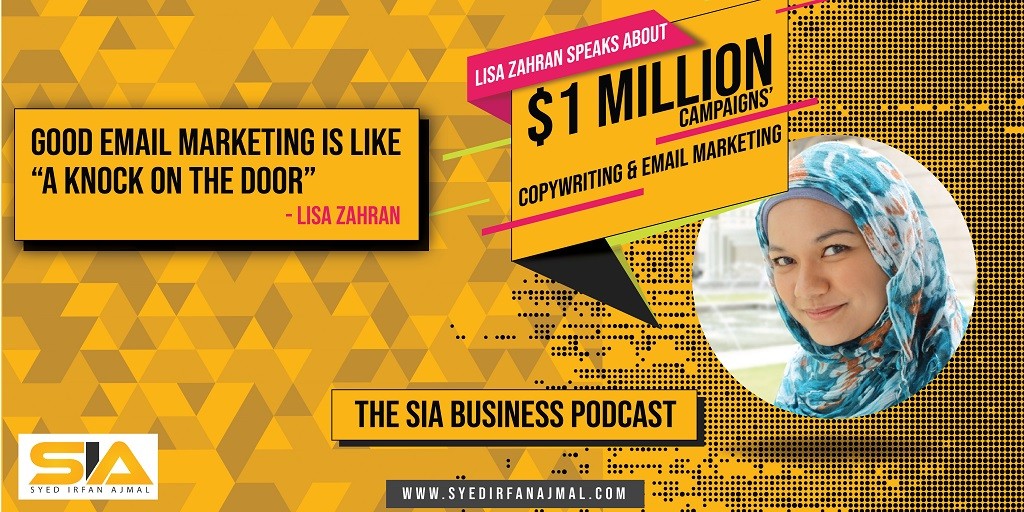
(48:38) Emails are like a knock on the door. It's like knocking on the door and saying, "Hey, you want to go watch the Avengers movie with me? It's really awesome. It's got a really great reviews." "Yeah?" "Okay, I've got tickets here. Here it is. Let's go." That's that. It's that invitation. That's a knock on the door. You're interrupting someone.
(49:05) The email is permission for people to make the decision. "Oh, I want to know more about this." And then you have their attention. Don't knock on the door barging, thinking you have their attention, and then just spell everything.
Lisa: (50:46) Okay. So, if it is planned sequence of emails, or a strategic launch and something where you build up the communication and then yes, it's okay to go more into detail for the email. So, your very first email of that sequence is going to be that very first knock, and you give them that teaser.
(51:15) People are already expecting that. You've already framed for people to expect that. You've already planted that seed of curiosity. And if you've written it well, you've planted the seed of curiosity where they're like, "Okay, I'm gonna make a point to meet this email tomorrow because I want to know more about this, and this and this."
(51:35) So, this is where sales emails or a launch sequence begins that way. When you look at the overall triggers in that sales email, it's actually a condensed sales speech that has been strategically split into many mini conversations.
(52:47) When planning, most importantly is respect. There's this term in cooking and my mom says to me all the time when I'm in the kitchen cooking, she says, "Respect the knife." And many chefs also say this, they say, "Respect the knife." When you respect the knife, you're cooking will be brilliant.
(53:41) Being online and being anonymous doesn't give you permission to behave in a way that you wouldn't behave offline. If you won't barge into someone's room without announcing or without making a prior appointment and then expect them to listen to you for 3 minutes, right? When they have no idea what you're talking about, or you haven't made an appointment. If you won't do that in real life, why would you do that in email?
Lisa: (54:34) One of the most important things, I think, that you should consider when you're hiring a copywriter, or you're planning to work with a copywriter is that your values are aligned and that there is a way, or some sort of passion… it doesn't have to be 100% exactly like you. Like, there is a relation. They can relate to your passion in one way or another, and they can relate to your values, one way or another.
(54:58) They can be the best copywriter, they can have the best experience, but if they do not resonate with your values or if they do not feel your passion, or they're not driven by your passion and values… that's not good because the copywriter is going to be the heart of the message that goes out.
Lisa: (58:02) Sure. I do have an eBook right now. It's on the mindsets of copywriting, and it's called, Unleash Your True Voice. About copywriting mindsets to influence, to create impact, and boost sales. It's on my website, Ikhlascopywriting.com, and the eBook is targeted to Muslim entrepreneurs, but I feel that it's also a universal message.
(58:30) A lot of people have this perception, this mindset, that in order to do sales we need to lie, we need to be that snake's oil salesman. Right? And there's this bad rep about sales being a manipulative thing. So, the essence of my book is that how should the best sales come from love and honesty and integrity.
Irfan: (01:00:06) I know, you have just started a coaching academy as well, so I wish you good luck on that as well, and we will include all the links to your website and the eBook and everything in the show notes for the listeners.
Lisa: (01:00:25) And thank you, Irfan, for holding the space for me and for giving way for an exciting conversation. I really enjoyed being on this show with you, and I look forward to seeing all the other interviews that you have on your show.
Irfan: (01:00:37) Thanks, Lisa. My pleasure. Bye-bye.
OUTRO: (01:00:41) Thank you for listening. For show notes and other resources, please refer to the description of the show.