Many of the sites we check on stage turn out to be partly or fully invisible to ChatGPT, Claude and Perplexity, and their owners had no idea. One click shows the score, the reasons and the fixes. And of the 16 other checkers we reviewed, this is the only one that shows the study behind each rule.
By Syed Irfan Ajmal, Fractional CMO · Updated 29 August 2026 · Runs in your browser, nothing leaves it

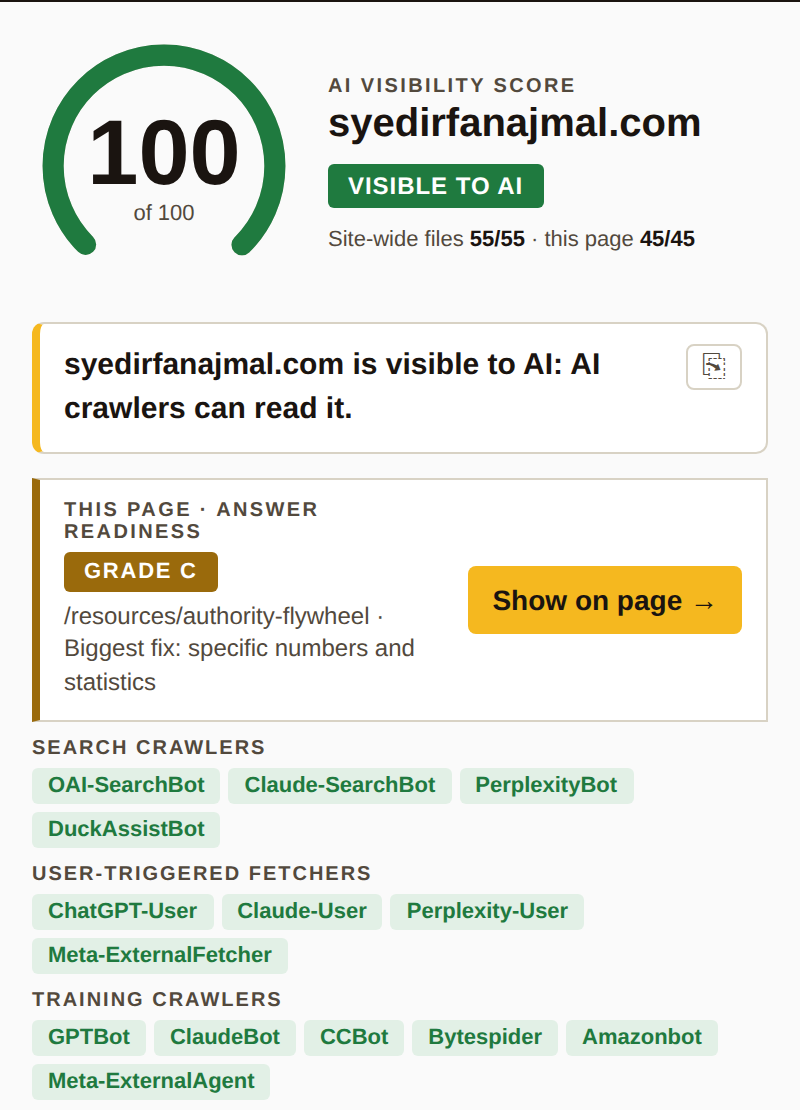
Sample.The extension run on this site’s own Authority Flywheel page, 28 Aug 2026: visibility 100 (site-wide files 55 of 55, that page 45 of 45), answer readiness grade C. Yours will differ.
Real lines from real checks. Each one names the place on the page, gives the measurement, and cites the rule, so a writer knows what to change and a client can verify the reasoning.
Some visibility checks belong to the whole site: robots.txt, llms.txt and the sitemap are the same on every page, and they carry 55 of the 100 points. The other 45 are measured on the page you have open, because JavaScript rendering and metadata differ page by page. The popup shows both numbers, so two pages of one site are never mistaken for two verdicts on the site. Whether AI would quote you is a third question, about one page only, so it gets its own grade instead of being folded in.
AI answers are assembled from pages that already look like answers. In 2025 and 2026, several teams measured which page features actually correlate with being cited, across tens of millions of citations. These ten checks are the ones the data supports, weighted by how strong the evidence is. Content pages only: a homepage or pricing page shows “n/a” rather than a bad grade.
| Check | Points | What it looks for | What the data found |
|---|---|---|---|
| A short, direct answer near the top of each section | 15 | One plain sentence of 6 to 20 words among the first two of each section, not a filler opener like 'In this article we will explore'. | 44% of ChatGPT citations come from the first 30% of a page. The exact sentences AI quotes average 9.8 words and never exceed 17. 67 |
| Sections of 80 to 250 words | 10 | Word count between one heading and the next. Stubs under 50 words and walls over 250 both lose points. | Sections of 120 to 180 words average 4.6 citations; sections under 50 words average 2.7. 25 |
| Sentences of 20 words or fewer | 8 | Share of sentences at or under 20 words. The report quotes your longest sentence. | No cited sentence in 42,971 citations was longer than 17 words; 92% were under 20. 7 |
| Lists, tables and definition sentences | 12 | Lists, tables and 'X is a...' sentences, about one per 400 words. | Pages with lists, tables or headings were matched to AI answers 91% of the time; prose-only pages 39%. 711 |
| Specific numbers and statistics | 12 | Data points inside real sentences, per 1,000 words. Label numbers in graphics do not count. | Pages with 19 or more data points average 5.4 citations; pages with few average 2.8. 2 |
| Quotes attributed to a named person | 8 | Quoted spans of four words or more with a name and a cue such as 'said' or a job title nearby. | Pages with expert quotes average 4.1 citations; pages without, 2.4. 2 |
| A visible, recent updated date | 10 | The newest date on the page or in its schema; full marks within 3 months. A date that lives only in the schema, invisible to readers, earns at most 6 of 10. A schema date newer than the visible date, or one that equals the scan date, is flagged. | Content updated within three months averages 6.0 citations vs 3.6. AI-cited content is 25.7% fresher than organic results, except on Google AI Overviews, where freshness is neutral. 29 |
| A named author readers can see | 12 | A visible byline, plus a credential line and a profile link. An author only in schema gets a quarter of the points. | Visible expertise and authorship signals were 30.6% more common on cited pages than on uncited ones, the second-largest text difference in the study. 8 |
| Named people, companies, products and places | 8 | Share of capitalised names among all words. | Cited passages run about 20% proper nouns; ordinary text runs 5 to 8%. 6 |
| No sales language | 5 | Share of sentences with promotional phrases ('game-changing', 'unlock', 'cutting-edge') or exclamation marks. | Promotional tone was the only text parameter negatively associated with being cited: 26% less common on cited pages. 8 |
| Total | 100 | Answer shape carries 45 points, substance 30, trust 25. | |
The biggest factor of all, how often other websites mention you, cannot be read from one page: across 75,000 brands it correlates with AI Overview presence at 0.66, three times more than backlinks 10. That is the question the Earned Media OS exists to answer.
Most AI-visibility tools still reward things the data says do not matter. This one lists them, gives them zero points, and says so on every result.
This is also how the tool itself changed. An external review pointed at the llms.txt data and its weight dropped from 10 points to 5. The answer-readiness spec started with a 30-point schema bucket and a question-heading check; the research pass killed both before a line was built.
Adobe’s AI Content Visibility Checker does one thing well: it shows how much of a page survives with JavaScript off. The small AEO and GEO extensions on the Chrome Web Store mostly hand back a number. Check by check:
| Check | AI Visibility Checker | Adobe | Typical AEO extension |
|---|---|---|---|
| Which AI crawlers robots.txt blocks, with the exact line | Yes, 16 bots | No | Partly |
| Text hidden behind JavaScript | Yes, 30 of 100 points | Yes, its whole product | Some |
| A grade for the page's shape as an answer, with the sentence behind each verdict | Yes, ten checks | No | A number only |
| The study and figure behind each rule, on screen | Yes | No | No |
| Says what it refuses to score, and why | Yes | No | No, most still reward schema |
| Warns when FAQ schema or a schema date does not match the visible page | Yes | No | No |
| Knows a homepage is not an article (shows n/a instead of a bad grade) | Yes | No | No |
| Paints facts, filler and long sentences on the live page | Yes, per sentence | Highlights hidden blocks | One tool, per sentence |
| Corrected robots.txt, starter llms.txt, client report, share card, compare view | Yes | No | Schema generators |
| Tracks whether AI actually mentions your brand The biggest factor in every study, and unmeasurable from one page. | No, on purpose: that is EMOS | In its paid parent product | Some, with your own API key |
Who is in the “typical” column: SAGE (828 users), RankSEO (688), SellOnLLM (619) and Zicy (456), per their Chrome Web Store listings on 28 August 2026; Adobe's AI Content Visibility Checker listed 10,000+ users the same day. Columns describe public listings and documentation, not hands-on tests.
Fair is fair: Adobe’s rendering check is polished and its paid parent product tracks real AI answers at scale, which this extension deliberately does not. If you need answer tracking, that is the EMOS platform, not a browser button.
The extension hands you a corrected robots.txt and a starter llms.txt on the spot, and the downloadable report explains every finding in plain words. Most sites can be fixed in an afternoon.
Browse the free playbooks →Being visible is step one. Being cited by AI when buyers ask is the game. EMOS Academy teaches founders the Earned Media OS: how coverage, authority and AI visibility compound.
See EMOS Academy →A fractional CMO engagement puts 22+ years of earned-media practice on your team: the fixes, the strategy and the coverage that makes AI quote you.
Book a discovery call →All of these are correlation studies unless noted; only the Ahrefs schema test approaches a controlled design. Sample sizes are given so you can weigh them yourself.
The AI Visibility Checker is heading to the Chrome Web Store. Until the listing is live, catch it in action at Irfan's talks and workshops, or ask for early access.